
Is a Police Report Required for a U Visa?
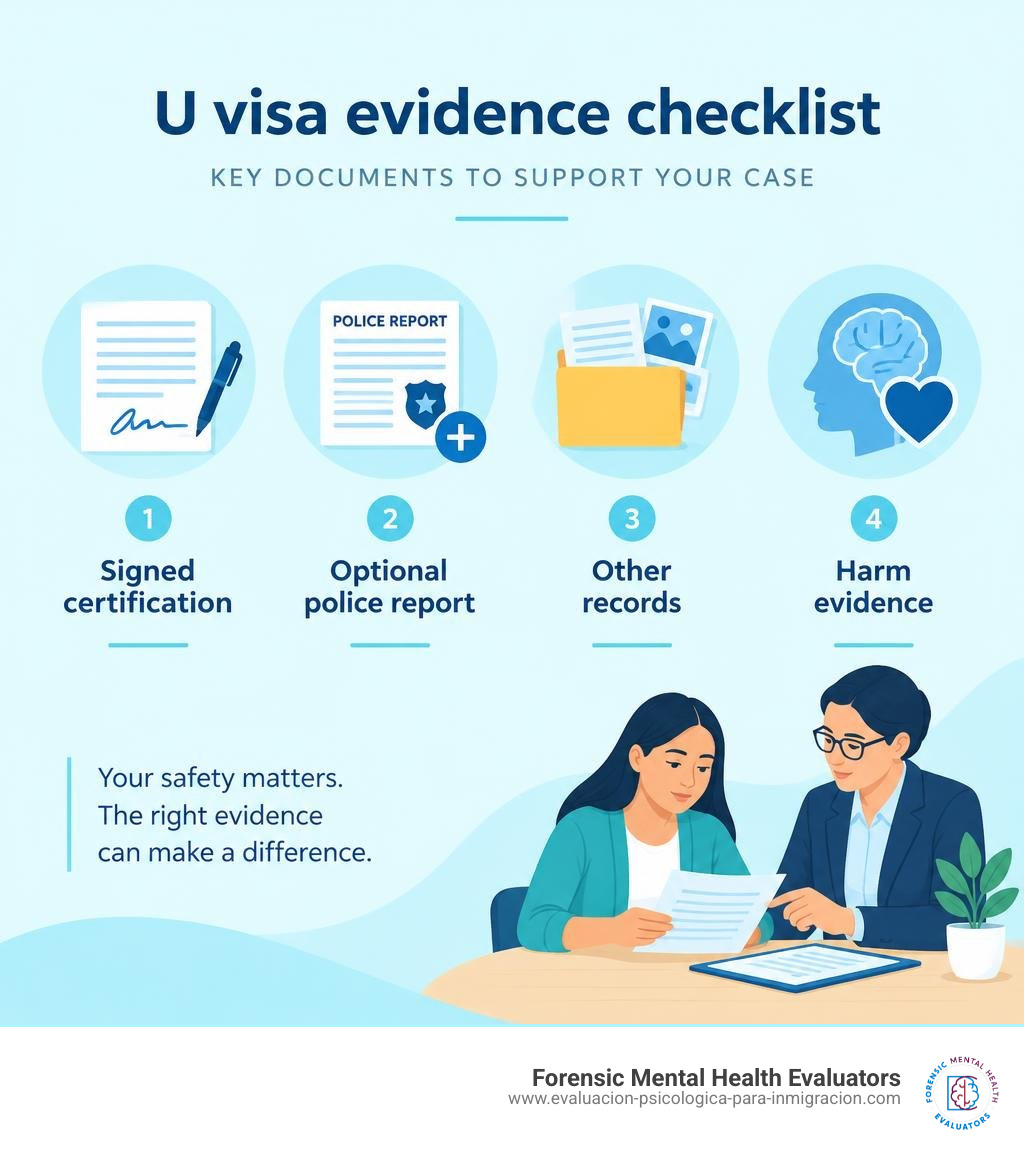
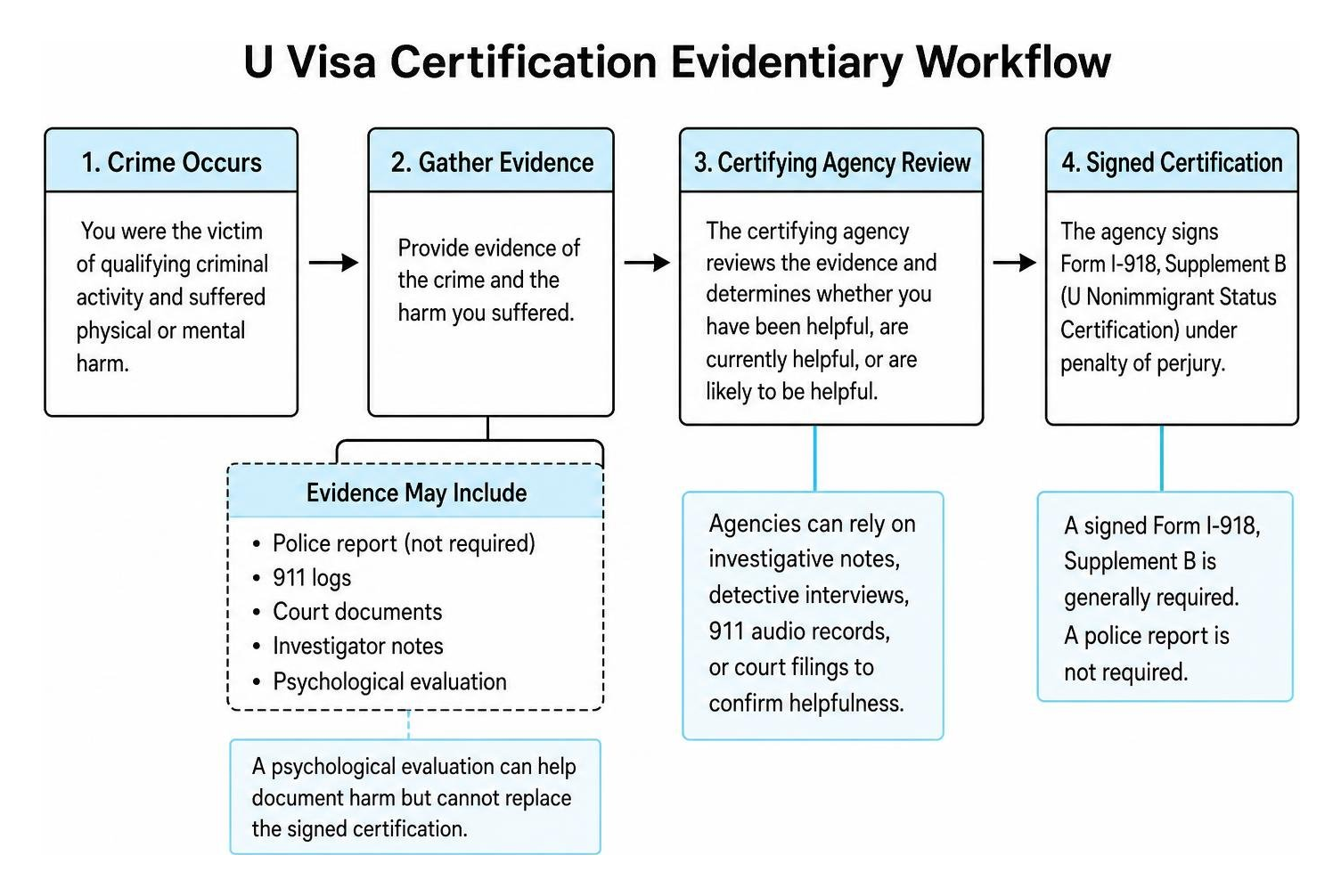
No. A police report is not required under the federal U visa rules. A signed Form I-918, Supplement B, is generally required. If your report is lost or was never made, ask the certifying agency whether it can review other records, such as 911 logs, court documents, or investigator notes. You will also need evidence of the crime and the physical or mental harm you suffered. A psychological evaluation can help document that harm, but it cannot replace the signed certification.
I’m Francisco Ortiz, a certified forensic mental health evaluator with experience assessing trauma in U visa cases. When clients ask whether a police report is required for a U visa, I help them understand what a clinical evaluation can document and what must come from a certifying agency.
Is a U Visa Police Report Required for Law Enforcement Certification?
To understand how the U nonimmigrant status works, we have to look at the legal framework established by United States Citizenship and Immigration Services (USCIS). According to the official USCIS U Nonimmigrant Status Guidelines, the U visa was created by Congress to strengthen the ability of law enforcement agencies to investigate and prosecute crimes while providing humanitarian protection to immigrant victims.
The cornerstone of the application is Form I-918, Supplement B (U Nonimmigrant Status Certification). This federal document confirms that:
- You were the victim of a qualifying criminal activity (such as domestic violence, felony assault, sexual assault, false imprisonment, or extortion).
- You possess credible information about the crime.
- You have been helpful, are currently helpful, or are likely to be helpful in the detection, investigation, or prosecution of that crime.
Many survivors assume that without an official police incident printout, the door is completely shut. However, federal immigration statutes do not state that an official police incident report is an absolute statutory prerequisite. What is strictly mandatory is the signed Form I-918 Supplement B itself. Law enforcement agencies have broad discretion when deciding whether to endorse this form. While most agencies use police reports as their primary basis for verification, an agency can rely on investigative notes, detective interviews, 911 audio records, or court filings to confirm your helpfulness.
Research shows how vital this pathway is for public safety: 73 percent of immigrants are more likely to participate in a criminal case after receiving a certification and filing a petition, and they are 50 percent more likely to file police reports if they experience future crimes.
Is a U Visa Police Report Required for Form I-918 Supplement B Signing?
When submitting Form I-918 Supplement B to an agency, the form must be completed and signed by an authorized certifying official under penalty of perjury. This official is typically the head of the agency (such as a Chief of Police, Sheriff, or District Attorney) or a designated supervisor authorized to sign on their behalf.
The certifying official must list specific statutory citations showing which local, state, or federal laws were violated. For an in-depth breakdown of how this petition fits into your broader immigration journey, consult our overview on filing an effective USCIS U Visa petition.
While the agency must verify the criminal acts, an applicant often wonders whether an existing case report must be attached. If an active detective handled your case or you provided witness testimony in court, the agency already maintains internal records confirming your helpfulness. In those circumstances, a formal incident printout is helpful supplementary documentation, but the agency's internal verification is what allows them to execute the Supplement B.
How Agency Policies Differ on Requiring Police Incident Reports
Because federal regulations grant certifying agencies discretion, internal protocols vary across jurisdictions. It is important to know the rules of the agency handling your request:
- California Agencies (e.g., LAPD): Under California Penal Code Section 679.10, state and local agencies must process certification requests within 30 days (or within an expedited 7-day window if the victim is in active immigration removal proceedings). The Los Angeles Police Department notes that while submitting an incident number or report copy speeds up the review, certifications can be evaluated using alternative case proof if a formal report is unavailable.
- New York Agencies (e.g., NYPD): The NYPD maintains a dedicated unit to process certification requests, as outlined in the NYPD U Visa Request Guidelines. They review underlying domestic incident reports, 911 dispatch logs, and detective division files to establish eligibility.
- Texas Agencies: Major municipal departments across Texas (including Houston, Austin, Dallas, and San Antonio) require clear identifying information—such as an incident number, date of occurrence, or investigator name—to pull the underlying files before endorsing Form I-918 Supplement B.
What Evidence Can Substitute When a Police Report Is Unavailable or Lost?

It is common for incident reports to go missing, become archived after years in storage, or contain clerical errors. If your case file cannot be found in the local records division, you do not have to abandon your application. To explore all pathways for gathering supporting documents, review our U Visa Complete Guide 2026.
Primary Documentation vs. Secondary Evidence Options
When primary police incident reports are unavailable, immigration regulations allow applicants to submit credible secondary evidence. Under federal evidentiary standards, such as those articulated in e-CFR 22 CFR § 42.65 Supporting Documents, when official public records are unobtainable through no fault of the applicant, secondary documentation and sworn statements may be presented to establish material facts.
Acceptable secondary evidence includes:
- 911 Call Transcripts and Computer-Aided Dispatch (CAD) Logs: These logs capture the exact time, caller identity, and nature of the emergency call.
- Temporary or Permanent Protective Orders: Judicial restraining orders contain sworn declarations, judicial findings of abuse, and docket entries confirming the violent conduct.
- Hospital, Paramedic, and Medical Records: Emergency room records detailing physical injuries, assault treatment, or forensic sexual assault examination results.
- Prosecutorial and Court Records: Subpoenas, charging instruments, plea agreements, trial transcripts, or victim-witness coordinator correspondence showing you assisted the prosecution.
- Child Protective Services (CPS) Case Files: Official state investigations into family violence or child endangerment.
- Sworn Affidavits from Credible Witnesses: Notarized declarations from neighbors, shelter advocates, case managers, or religious leaders who witnessed the crime or provided immediate refuge.
Steps to Take If Your Police Report Is Incomplete or Expunged
If you discover that your police report has missing pages, misidentifies you as a bystander rather than the primary victim, or was purged after an administrative retention period:
- Submit an In-Person Records Request: Visit the central records or identification division of the investigating law enforcement department. Request a full archival search using all possible name spellings, aliases, dates of birth, and historical addresses.
- File a Formal Public Records or FOIA Request: Submit a written open records request under your state's public information act (or the federal Freedom of Information Act if a federal agency investigated).
- Contact the Assigned Detective or Investigative Unit: Speak directly with the investigative division that handled the case. Detectives often retain supplementary case notes, interview logs, or photographic evidence not included in the initial patrol summary.
- Prepare a Detailed Personal Sworn Affidavit: Draft a detailed personal statement explaining the timeline of the crime, how you reported it, every interaction you had with responding officers, and why the official agency report is missing or incomplete.
Documenting Substantial Physical or Mental Abuse Without Official Police Records

Beyond proving that a qualifying crime took place and that you cooperated with law enforcement, federal law requires you to prove that you suffered substantial physical or mental abuse as a result of the criminal activity.
USCIS adjudicators examine several factors when evaluating substantial harm:
- The severity and nature of the criminal acts.
- The severity of the harm inflicted on your physical and emotional well-being.
- The duration of the suffering.
- Any permanent or serious damage to your physical health, mental health, or day-to-day functional capacity.
When official police reports are sparse or unavailable, detailed clinical documentation becomes the primary evidence establishing this statutory requirement. Our clinical team specializes in conducting a thorough U Visa Psychological Assessment to ensure your trauma and psychological injuries are fully documented for immigration authorities.
When Is a U Visa Police Report Required Versus Clinical Evidence?
It is essential to understand the division of labor between law enforcement records and clinical mental health evaluations:
- Law Enforcement Documentation (Police Reports & Form I-918B): Proves the external event—that a qualifying crime occurred within U.S. jurisdiction and that you assisted authorities.
- Clinical Psychological Evaluations: Proves the internal impact—the subjective emotional, cognitive, behavioral, and psychiatric injuries resulting from that crime.
An incident report might state only that an assault occurred, with a brief notation like "victim appeared upset." A police officer is not a trained clinician and cannot diagnose complex trauma. A comprehensive Mental Health Assessment for U Visa provides the formal psychiatric diagnosis, clinical psychometric test results, and developmental trauma narrative necessary to prove substantial mental harm to USCIS.
The Role of Psychological Evaluations in Proving Harm
In our forensic evaluations at District Counseling, we apply validated psychological instruments to document conditions such as Post-Traumatic Stress Disorder (PTSD), Major Depressive Disorder, Generalized Anxiety Disorder, and Panic Disorder.
Our comprehensive evaluations include:
- Standardized psychological testing (e.g., PAI, TSI-2, PCL-5, BDI-II) administered in your primary language.
- A detailed clinical history establishing your psychological functioning before and after the crime.
- Explicit clinical connections linking your current symptoms directly to the traumatic criminal incident.
- An assessment of how ongoing fear, hypervigilance, and trauma interfere with your daily life, employment, and parenting.
For Spanish-speaking survivors, our complete Evaluacion Psicologica para Caso de Uvisa ensures your narrative is accurately translated and clinically documented.
Comparing Evidence Standards: U Visa vs. T Visa and VAWA Petitions
Understanding whether an official police report is required depends heavily on the specific humanitarian immigration protection you are seeking. Survivors of abuse or exploitation often qualify for more than one legal remedy.
Securing nonimmigrant status under these programs can open the door to permanent residence; learn more about the transition from U Visa to Green Card.
The table below outlines the evidentiary differences across the three major humanitarian programs:
| Humanitarian Category | Required Law Enforcement Certification? | Is a Police Report Mandatory? | Cooperation / Helpfulness Standard | Primary Focus of Harm Documentation |
|---|---|---|---|---|
| U Visa (Victims of Qualifying Crimes) | Yes (Form I-918, Supplement B is mandatory) | No (Strongly recommended, but secondary proof accepted) | Must be helpful, currently helpful, or likely to be helpful in investigation/prosecution | Substantial physical or mental abuse resulting from the crime |
| T Visa (Victims of Severe Human Trafficking) | No (Form I-914, Supplement B is optional) | No (Trafficking can be proven through self-declarations and clinical evidence) | Must comply with reasonable requests for assistance (unless exempt due to trauma/age) | Extreme hardship involving unusual and severe harm upon removal |
| VAWA Self-Petition (Spouse/Child/Parent of USC/LPR) | No (No law enforcement involvement required) | No (Any credible evidence standard applies) | None (No requirement to report abuse to police or cooperate with authorities) | Battery or extreme cruelty committed by a qualifying relative |
Congress established an annual statutory cap of 10,000 principal U visas per fiscal year (October 1 through September 30). With over 30,000 petitions filed annually in recent years, thorough and organized evidence—including clinical assessments and secondary records—is critical to preventing requests for evidence (RFEs) or procedural delays.
Frequently Asked Questions About U Visa Police Documentation
Can I qualify for a U visa if I never filed a formal police report?
Yes, under certain circumstances. If you never called 911 or filed a report at a local police precinct, you may still qualify if another authorized certifying agency investigated the underlying criminal conduct.
Qualifying certifiers include:
- County or City District Attorney's Offices and Prosecutors.
- State or Federal Judges who presided over proceedings involving the crime.
- Child Protective Services (CPS) or adult protective investigative units.
- The Equal Employment Opportunity Commission (EEOC) or Department of Labor (for workplace crimes, extortion, or trafficking).
If any of these qualifying bodies investigated the crime and you cooperated with their inquiries, they have the legal authority to sign your Form I-918 Supplement B even in the absence of a municipal police report.
How long is a signed Form I-918 Supplement B valid after certification?
A signed Form I-918 Supplement B is valid for exactly six months (180 days) from the date the certifying official signs and dates the document.
You must file your completed U visa application package (Form I-918, Supplement B, personal affidavits, clinical evaluation, and supporting exhibits) with USCIS before that six-month window expires. If the certification expires before filing, USCIS will reject the application, and you will have to request a new signature from the certifying agency.
What should I do if the police department refuses to sign my certification?
Law enforcement agencies are not legally required by federal statute to sign Form I-918 Supplement B; signing is within their administrative discretion. If a municipal police department declines:
- Review the Reason for Denial: Common reasons include lack of jurisdiction, administrative policy limits on older cases, or a misunderstanding of your cooperation.
- Submit an Administrative Appeal or Reconsideration: Many agencies (including the LAPD and NYPD) allow you to submit a formal letter of reconsideration with additional corroborating evidence.
- Approach Alternative Certifying Authorities: If the case was forwarded to prosecutors, request certification from the District Attorney's Office or the presiding judge.
- Evaluate Other Immigration Relief: If certification cannot be obtained, consult your immigration attorney to see if you qualify for a T Visa, VAWA self-petition, or Asylum, none of which require a mandatory law enforcement certification.
Conclusion
Navigating the evidentiary requirements for a U visa can feel overwhelming, especially when official records are incomplete or missing. While federal regulations do not make an official police incident report an absolute statutory requirement, securing a signed Form I-918 Supplement B and proving substantial physical or mental harm are essential to a successful petition.
At District Counseling, we provide thorough, trauma-informed psychological evaluations for immigration cases across our offices in Houston, Katy, Cypress, and Sugar Land, Texas, as well as clients throughout Texas, Florida, California, New York, Utah, Virginia, and Idaho.
We ensure that language is never a barrier by conducting evaluations directly in Spanish and providing certified English translations for your legal team and USCIS. To support your ongoing healing, every evaluation package includes six complimentary therapy sessions post-report.
If you are preparing your humanitarian petition and need clinical documentation of trauma, schedule an evaluation for your USCIS U Visa petition with our forensic mental health team today.