
What to Do If Your T Visa Is Denied

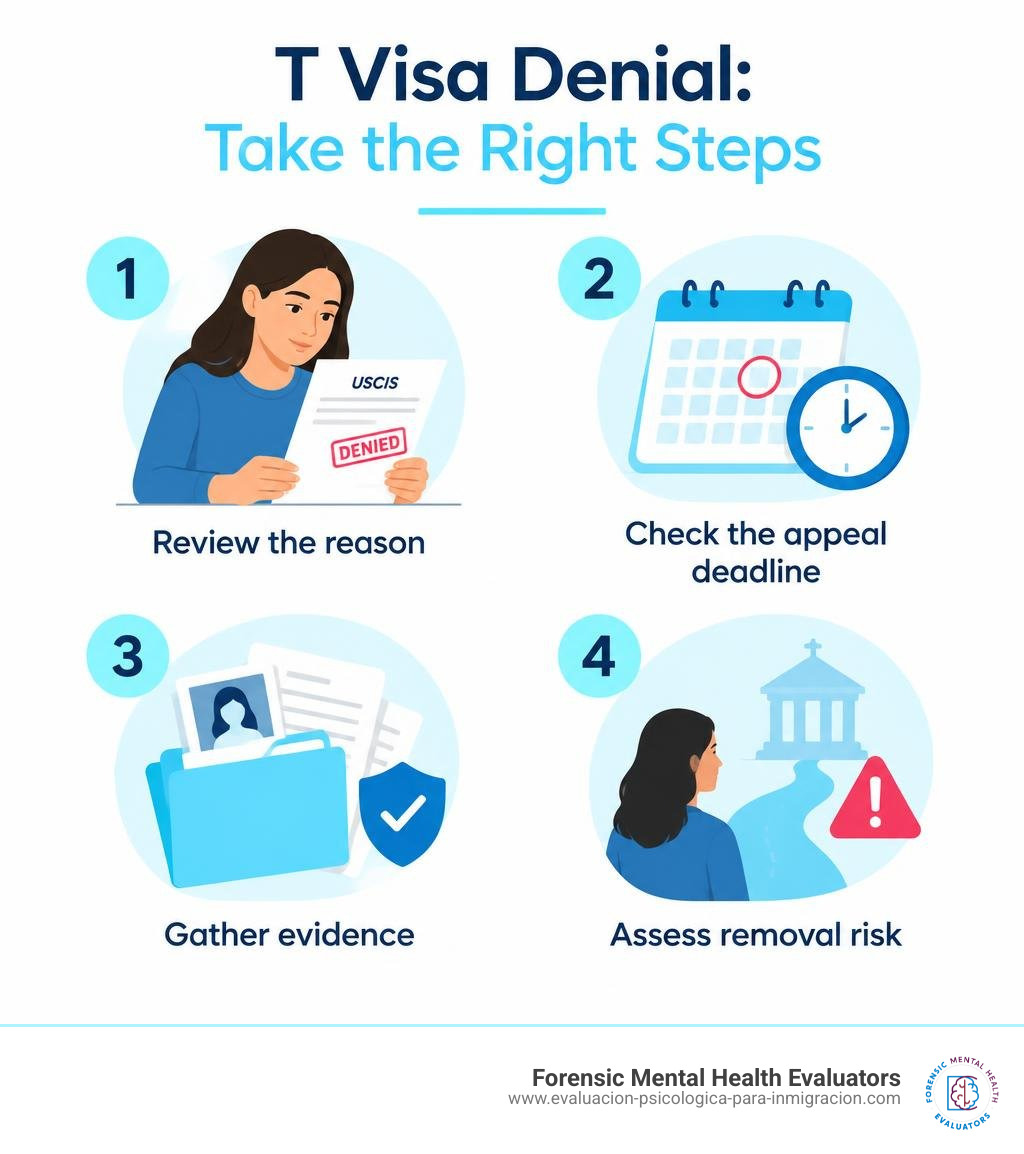
If your T visa is denied, read the denial notice and check the deadline right away. USCIS may have found that evidence was missing, an eligibility rule was not met, or a form was incomplete. You may be able to file an appeal or a motion to reopen or reconsider, often within 30 days of the decision, or 33 days if USCIS mailed it. A denial does not mean immediate deportation, but it can raise the risk of removal proceedings. Speak with an immigration attorney before the deadline passes.
I’m Francisco Ortiz, a forensic mental health evaluator trained to assess the effects of trafficking and trauma. For people searching “t visa denied,” I’ll explain how a psychological evaluation may help document evidence while an immigration attorney advises on the legal response. When a T visa is denied, the decision is not necessarily final, and understanding the reason for the denial is the first step toward a stronger response.
Common Reasons Your T Visa Is Denied by USCIS
Receiving a denial letter from U.S. Citizenship and Immigration Services (USCIS) can be heartbreaking, especially after enduring severe trauma and waiting months for an answer. However, understanding exactly why an adjudicator rejected your petition is the first step toward building a winning response.
In human trafficking cases, the legal threshold is the preponderance of the evidence standard. This means you must show that your claims are "more likely true than not." Even though Congress established an annual statutory cap of 5,000 T visas per year, historical data shows that USCIS routinely grants fewer than 2,000 annually. Between 2014 and 2019, T visa denials increased by more than 250 percent, and denial rates climbed to 42 percent in fiscal year 2020. Requests for Evidence (RFEs) more than doubled from 638 in 2018 to 1,475 in 2020, signaling intense adjudicative scrutiny.
| Common Denial Ground | Why USCIS Rejects the Claim | Key Evidence Needed to Overcome Denial |
|---|---|---|
| Physical Presence Gap | Officer claims you escaped trafficking years ago and remained voluntarily | Detailed psychological report proving trauma-induced paralysis or ongoing fear |
| Trafficking Definition Not Met | Lack of documented force, fraud, or coercion in labor or commercial sex | Detailed personal declarations, witness affidavits, work logs, threatening messages |
| Law Enforcement Assistance | Failure to respond to reasonable requests from investigators | Police contact logs, hotline call records, or trauma exemptions under 8 CFR § 214.11 |
| Inadmissibility Issues | Unlawful entries, criminal history, or immigration fraud without a waiver | Approved Form I-192 extreme hardship waiver demonstrating rehabilitation and positive equities |
| Defective Signatures or Forms | Stamped, digital, or copied signatures on non-electronic forms | Original wet-ink signed forms and complete responses to blank fields |
Failure to Meet Physical Presence and Trafficking Definitions
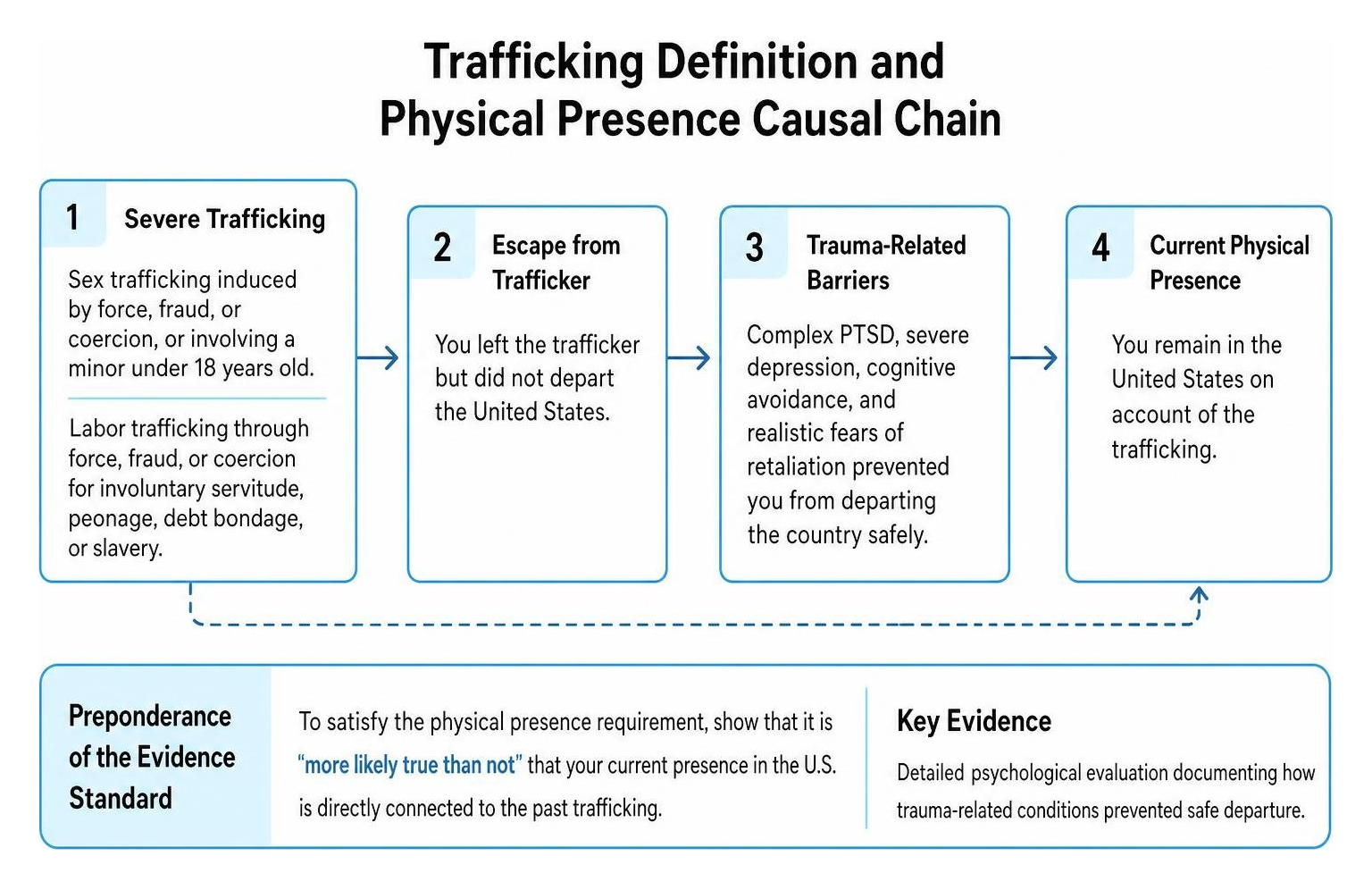
To satisfy the statutory T visa eligibility criteria, you must establish that you are physically present in the United States "on account of" a severe form of trafficking in persons. Under federal law, severe trafficking encompasses:
- Sex trafficking induced by force, fraud, or coercion, or involving a minor under 18 years old.
- Labor trafficking involving the recruitment, harboring, transportation, provision, or obtaining of a person for labor or services through force, fraud, or coercion for involuntary servitude, peonage, debt bondage, or slavery.
As highlighted in the BOSTON UNIVERSITY ACCESS report, the physical presence requirement has historically accounted for up to 43 percent of T visa rejections. Officers frequently argue that if time passed between your escape from the trafficker and your filing date, your ongoing presence in the U.S. is no longer directly connected to the trafficking.
To overcome this narrow interpretation, you must demonstrate the direct causal chain connecting your past victimization to your current presence. This is where a specialized T visa psychological evaluation proves decisive. Clinical evaluations document how complex Post-Traumatic Stress Disorder (PTSD), severe depression, cognitive avoidance, and realistic fears of retaliation prevented you from departing the country safely.
Procedural Errors, Inadmissibility, and Signature Defects
Procedural missteps remain a leading cause of avoidable denials. USCIS adjudicators enforce strict technical guidelines regarding how petitions must be executed.
According to a key USCIS AAO signature precedent decision, an applicant’s Form I-914 application must bear an original, handwritten wet-ink signature. Submitting a scanned signature, a digital image pasted onto a PDF, or a signature applied by a notary on your behalf will result in an immediate rejection or denial that cannot easily be cured retroactively.
Other critical procedural issues include:
- Inadmissibility Grounds Without Form I-192: If you entered without inspection, used false documentation to work, or accumulated unlawful presence, you must submit Form I-192 (Application for Advance Permission to Enter as a Nonimmigrant). Failing to document why your inadmissibility should be waived on humanitarian grounds will trigger a denial.
- Form I-914 Supplement B Misconceptions: While a law enforcement declaration (Supplement B) is powerful evidence, it is not legally mandatory for a T visa (unlike a U visa). However, if you do not include Supplement B, you must submit secondary evidence proving you reported the crime or were exempt due to severe psychological trauma.
- Incomplete Responses to RFEs or NOIDs: Missing a deadline for a Request for Evidence or Notice of Intent to Deny almost always leads to a swift denial.
Deportation Risks, Notices to Appear, and Confidentiality Protections
One of the most pressing questions survivors ask after a denial is whether immigration officers will show up at their home to deport them. While a denial increases vulnerability, strong federal statutes exist to shield survivors from targeted enforcement.
Understanding NTA Policies and Removal Proceedings
A Notice to Appear (NTA) is the charging document that places an individual into formal removal proceedings before an immigration judge. Under the 2018 NTA Policy Memo, USCIS expanded its practice of issuing NTAs when denying affirmative humanitarian applications. Between 2019 and 2021, USCIS issued 236 NTAs to denied T visa applicants.
As detailed in the ILRC practice advisory on affirmative T visa risks, policy updates published in August 2024 significantly curtailed automatic NTA issuance for humanitarian cases, reserving referrals primarily for individuals with serious criminal records, national security concerns, or proven immigration fraud.
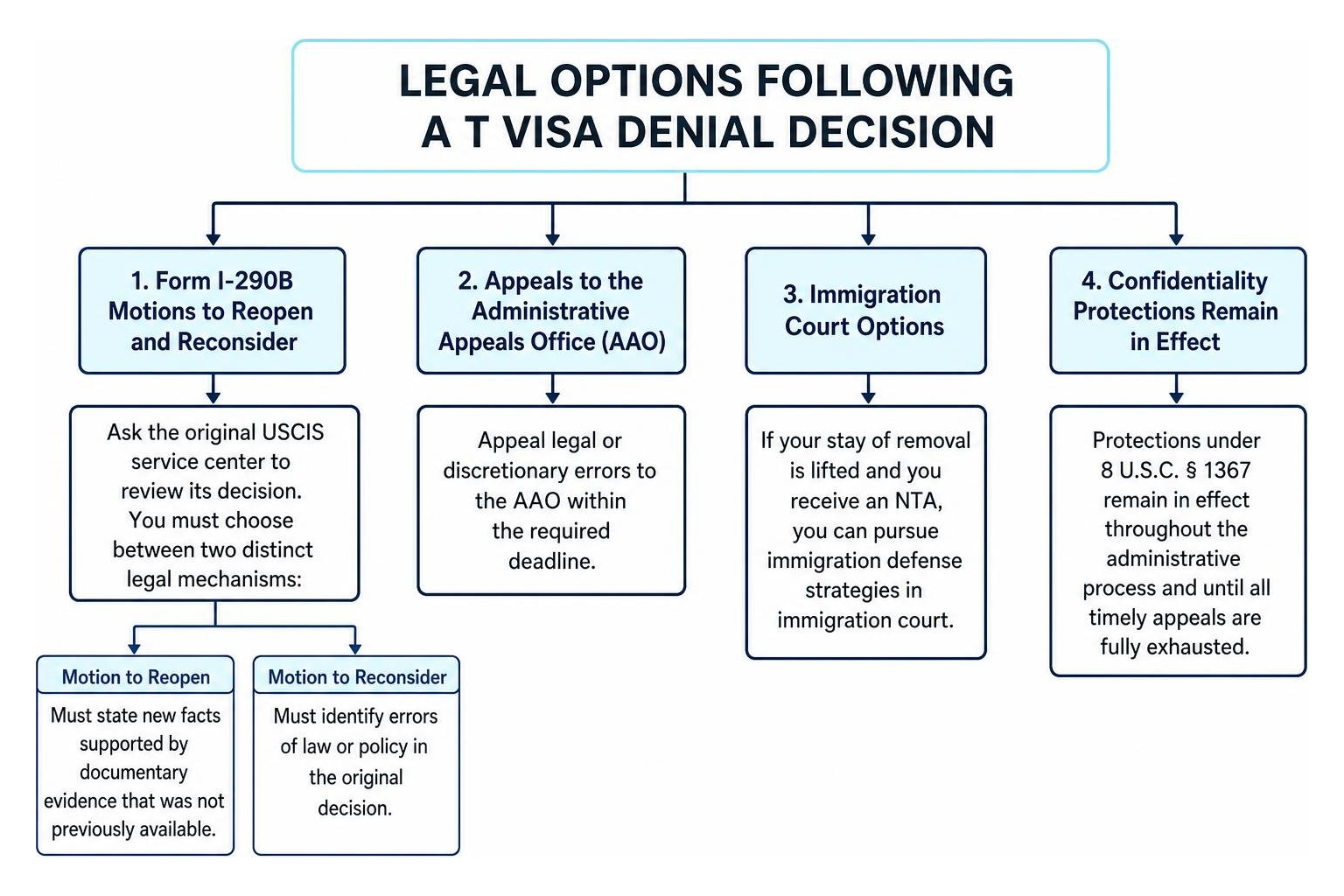
If your stay of removal is lifted following a final denial, an attorney can evaluate whether to pursue immigration deportation defense strategies in immigration court.
Statutory Confidentiality Protections Under 8 U.S.C. § 1367
Congress recognized that traffickers often use the threat of deportation as a weapon of control. To protect survivors, federal law enacted 8 U.S.C. § 1367, which establishes strict confidentiality mandates:

- Prohibition on Adverse Determinations: The Department of Homeland Security (DHS) cannot make an adverse immigration determination using information provided solely by a trafficker, abuser, or perpetrator of the crime.
- Strict Use Restrictions: DHS officials are prohibited from disclosing any information about your T visa filing to third parties.
- Safe Mailing Addresses: You have the absolute right to designate a safe mailing address (such as your attorney's office) to ensure sensitive correspondence or NTAs are not sent to a location where your safety could be compromised.
These statutory protections remain in effect throughout the administrative process and continue until all timely appeals are fully exhausted.
Legal Options to Challenge a Denial: Appeals, Motions, and Deadlines
If your petition was rejected, you have several formal pathways to challenge the decision or introduce new supporting evidence.
Form I-290B Motions to Reopen and Reconsider
Filing Form I-290B allows you to ask the original USCIS service center to review its decision. You must choose between two distinct legal mechanisms:
- Motion to Reopen: Must state new facts supported by documentary evidence that was not previously available. For instance, if your original filing lacked comprehensive clinical documentation, submitting a thorough psychological trauma evaluation for immigration provides the objective diagnostic data required to reopen the matter.
- Motion to Reconsider: Argues that the adjudicating officer made an error of law or USCIS policy based on the record already submitted.
Crucial Deadline: You must file Form I-290B within 30 calendar days of the decision date, or 33 calendar days if the decision was served by mail. USCIS strictly enforces this timeline; late filings are dismissed without review.
Administrative Appeals Office (AAO) Review and Federal APA Litigation
If the field office refuses to reopen your case, or if you choose an appeal directly, you can appeal to the Administrative Appeals Office (AAO).
- De Novo Standard of Review: The AAO conducts a fresh review of the entire record without giving deference to the prior officer's legal conclusions or factual interpretations under established USCIS policy on T nonimmigrant status.
- Federal Court Litigation (Administrative Procedure Act): If the AAO upholds an unlawful denial, you can file a lawsuit in U.S. District Court under the Administrative Procedure Act (APA). APA lawsuits challenge agency actions that are arbitrary, capricious, or contrary to federal law. Federal judges frequently scrutinize agency overreach and require USCIS to re-adjudicate cases where officers ignored compelling clinical testimony.
Reapplying After a T Visa Is Denied: How to Build a Stronger Case
Filing a brand-new Form I-914 application is often faster and more cost-effective than pursuing lengthy administrative appeals—especially when your initial application suffered from severe evidentiary deficiencies.
When reapplying, never submit identical paperwork. You must systematically cure every defect listed in your denial notice:
- Secure a comprehensive forensic mental health evaluation detailing your trafficking experience, clinical diagnoses, and the psychological impact of returning to your home country.
- Provide supplementary affidavits from social workers, medical providers, shelter staff, or community advocates.
- Include police reports, hotline records, or corroborating communications (text messages, social media logs) demonstrating force, fraud, or coercion.
Alternative Humanitarian Relief Options After Denial
If an appeal or reapplication for a T visa is not legally viable, you may qualify for other forms of humanitarian immigration relief.
Applying for U Visa Status or VAWA Self-Petitions
- U Nonimmigrant Status: If you were the victim of certain qualifying crimes (such as felonious assault, domestic violence, extortion, or false imprisonment) and assisted law enforcement, a U visa mental health assessment can help prove you suffered substantial mental or physical abuse.
- VAWA Self-Petitions: If you were abused by a U.S. citizen or lawful permanent resident spouse or parent, you can file a VAWA self-petition evaluation to seek legal status independently.
- Employment Authorization: While awaiting processing for these relief pathways, you may be eligible for interim deferred action and a work permit authorization.
Seeking Asylum and Cancellation of Removal
- Asylum Protection: If you possess a well-founded fear of persecution in your home country based on your race, religion, nationality, political opinion, or membership in a particular social group, you can file for affirmative and defensive asylum claims. A specialized psychological assessment for asylum substantiates past persecution and fear of future torture.
- Non-LPR Cancellation of Removal: If placed in removal proceedings, you might qualify for cancellation of removal defense if you have lived in the U.S. continuously for 10 years and your removal would cause exceptional and extremely unusual hardship to a qualifying U.S. citizen or LPR relative, supported by robust extreme hardship waiver documentation.
Action Plan: Navigating Next Steps After a Denial
Taking organized, swift action is essential to protect your rights after receiving an adverse decision.

What to Do Immediately After Your T Visa Is Denied
- Verify the Date of the Notice: Locate the formal decision date at the top of the letter. Calculate your 33-calendar-day deadline immediately.
- Consult an Immigration Attorney: Never attempt to file an appeal or motion without experienced legal counsel specializing in trafficking cases.
- Obtain Your Complete File: Request a full copy of your previously submitted Form I-914 package, including all RFE responses and exhibits.
- Schedule an Updated Psychological Evaluation: If your initial case lacked psychiatric or mental health evidence, schedule an evaluation immediately to document trauma symptoms, cognitive functioning, and fear of return.
- Establish Safety and Wellness Protocols: Connect with victim service organizations, social workers, and licensed mental health clinicians to ensure your ongoing safety and emotional stability.
Frequently Asked Questions About T Visa Denials
Can I apply for a work permit if my T visa is denied?
No. If your primary Form I-914 is denied, any concurrent Form I-765 (Application for Employment Authorization) based on pending status or a preliminary bona fide determination is automatically denied or revoked. You cannot legally renew your work permit under T nonimmigrant status unless your case is successfully reopened or approved on appeal.
How long do I have to appeal a T visa denial decision?
You have 30 calendar days from the date of the decision to file Form I-290B. If the decision was mailed to you, USCIS adds 3 calendar days, giving you a total of 33 days. If this deadline falls on a weekend or federal holiday, the due date extends to the next business day. Missing this strict window forfeits your administrative appeal rights.
Does receiving a T visa denial mean immediate deportation?
No. A denial does not result in immediate physical deportation. To deport someone, the government must issue a Notice to Appear and file it with the Executive Office for Immigration Review (EOIR). You are entitled to a full hearing before an immigration judge, where you can present legal defenses, challenge allegations, or apply for alternative forms of immigration relief.
Conclusion
Facing a denial after surviving human trafficking is deeply distressing, but an adverse decision from USCIS is not the end of your legal journey. With the right legal counsel and rigorous documentary evidence, many survivors successfully overturn denials through motions to reopen, appeals, or newly filed petitions.
At District Counseling, we provide specialized forensic mental health evaluations for survivors navigating complex immigration cases across Texas, including Houston, Austin, Dallas, and San Antonio, as well as clients in Katy, Cypress, and Sugarland. We conduct comprehensive Spanish-language evaluations that are seamlessly translated into English, ensuring you feel comfortable and understood throughout the assessment process. Furthermore, we support your ongoing healing by providing 6 free therapy sessions post-report.
If you are preparing to appeal or reapply, talk to your attorney about scheduling an expert psychological evaluation for T visa cases to ensure your story is told with the clinical depth, precision, and dignity it deserves.