
How the Immigration Removal Process Works

The immigration removal process usually begins when the government files a Notice to Appear with an immigration court. At an initial hearing, a judge reviews the charges and gives the person a chance to respond. A later hearing may cover evidence and requests to remain in the United States. The judge then decides the case. An appeal may be possible, but deadlines are strict.
If you receive a Notice to Appear, check your hearing date, keep your address current with the court, and speak with an immigration attorney as soon as you can. If separation from your spouse or children would cause serious hardship, tell your attorney so they can assess what evidence may help your case.
I'm Francisco Ortiz, a certified forensic mental health evaluator with experience assessing hardship, trauma, and a person's ability to participate in immigration court. My work helps document mental health concerns relevant to the removal process immigration courts oversee.
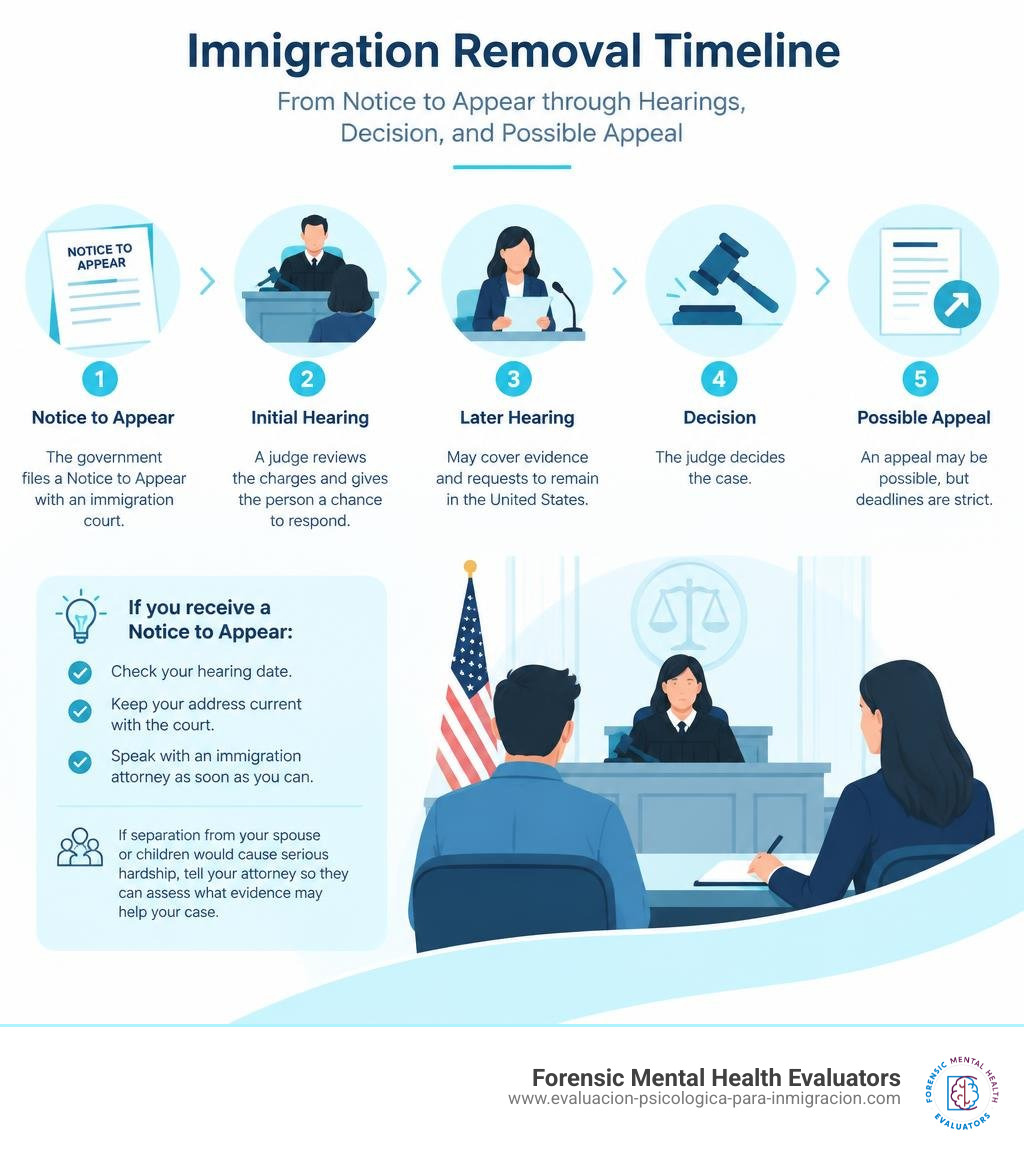
Key Stages in the Removal Process Immigration Framework
When the Department of Homeland Security (DHS) seeks to expel a noncitizen from the United States, it initiates formal civil deportation proceedings. These proceedings are administered by the Executive Office for Immigration Review (EOIR), an agency within the Department of Justice (DOJ). Immigration judges act similarly to administrative judges, determining whether an individual is removable and evaluating requests for relief.
Although these proceedings are civil rather than criminal, the constitutional safeguards of the Fifth Amendment apply, guaranteeing noncitizens due process. As detailed in Congressional research on formal removal proceedings, understanding each procedural stage ensures that respondents assert their rights effectively against Immigration and Customs Enforcement (ICE) prosecutors.
Notice to Appear and Initial Charging Allegations
The formal immigration removal process begins when DHS issues and files Form I-862, known as the Notice to Appear (NTA). The NTA serves as the government's charging document. It outlines key jurisdictional facts, including:
- The respondent's country of origin and citizenship status.
- The date and manner of arrival in the United States.
- Factual allegations detailing why the entry or continued presence is unlawful.
- The specific statutory grounds of inadmissibility or deportability under the Immigration and Nationality Act (INA).
Respondents must maintain an up-to-date mailing address with the immigration court. Under EOIR rules, any change of address must be submitted within five business days using Form EOIR-33. Failing to update an address can lead to missed court notices and summary orders of deportation. For a complete look at detainee rights, refer to the ABA manual on detainee rights and removal defense.
Master Calendar Hearings and Bond Determinations
The initial appearance in immigration court is the Master Calendar Hearing. This hearing functions much like a preliminary arraignment. The immigration judge verifies identities, ensures language access via an interpreter, takes formal pleadings regarding the NTA allegations, and allows the respondent to designate a country of removal if ordered deported.
If a noncitizen is detained by ICE, custody redetermination is often the top priority. Under INA § 236(a), an immigration judge can set a monetary bond (with a statutory minimum of $1,500) or release an individual on conditional parole if they prove they are not a danger to the community or a flight risk. However, individuals subject to mandatory detention under INA § 236(c)—typically due to specific criminal grounds—are generally ineligible for bond hearings before the judge. Understanding how to stop ICE deportation through timely custody motions is critical during these early detention phases.
Individual Merits Hearing and Evidentiary Filings
The final evidentiary stage is the Individual Calendar (or Merits) Hearing. During this substantive trial, the respondent presents their legal defenses and applications for relief.
Both the respondent and ICE trial counsel submit documentary evidence prior to strict court call-up dates. During the hearing:
- The respondent and supporting witnesses provide oral testimony under oath.
- Legal counsel conducts direct examination to establish the core elements of the defense.
- ICE trial attorneys conduct cross-examination.
- Expert witnesses, such as forensic mental health evaluators and country condition experts, provide specialized insight.
Establishing facts through comprehensive psychological evaluations and objective reports is often decisive during cancellation removal proceedings.
How Expedited Removal Differs from the Standard Removal Process Immigration
Not every noncitizen receives a full hearing before an immigration judge. Under INA § 235(b)(1), established by the Illegal Immigration Reform and Immigrant Responsibility Act (IIRIRA) of 1996, DHS utilizes expedited removal. This summary process allows low-level immigration officers to issue deportation orders without judicial oversight.
Expedited removal peaked in FY 2013 when approximately 197,000 individuals were removed under these provisions, representing 46 percent of all removals that year. Since Title 42 ended in May 2023, immigration officers have placed over 20,000 migrants each month in the expedited removal pipeline.
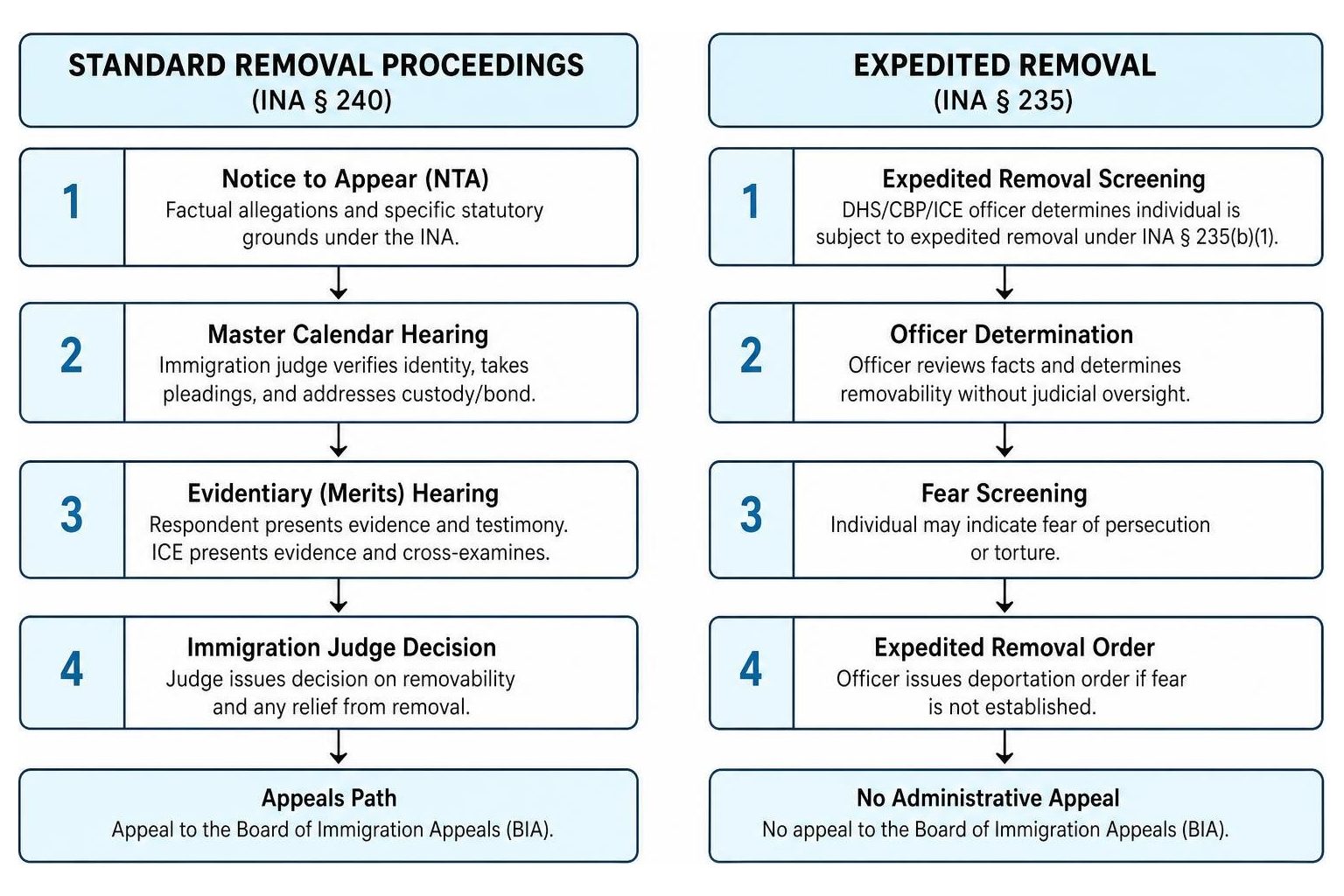
| Procedural Aspect | Standard Removal (INA § 240) | Expedited Removal (INA § 235) |
|---|---|---|
| Adjudicator | DOJ Immigration Judge | DHS / CBP / ICE Officer |
| Court Hearing | Full evidentiary merits hearing | No judicial hearing unless fear established |
| Appeals Path | Board of Immigration Appeals (BIA) | No administrative appeal |
| Applicability | Noncitizens inside the U.S. or with valid entry claims | Border encounters or noncitizens present < 2 years |
| Fear Screening | Formal defensive asylum application | Credible fear interview by USCIS Asylum Officer |
If an individual subject to expedited removal expresses a fear of return, the officer must refer them to an asylum officer for a credible fear screening. Passing this screening revokes the summary order and places the person into standard INA § 240 proceedings.
Grounds for Removal: Inadmissibility vs. Deportability
U.S. immigration law divides removal charges into two distinct legal categories: grounds of inadmissibility and grounds of deportability. Understanding this distinction determines the legal standards, available waivers, and burdens of proof that apply in court, as outlined in the ILRC guide on legal defense in removal proceedings.
- Inadmissibility (INA § 212): Applies to individuals who are arriving at a port of entry, entered without inspection, or are seeking an adjustment of status or a visa. Grounds include health-related conditions, unlawful presence, fraud or willful misrepresentation, and public charge determinations.
- Deportability (INA § 237): Applies to noncitizens who were lawfully inspected and admitted to the United States (such as lawful permanent residents, visa holders, or refugees) but subsequently violated their status or committed disqualifying acts.
Criminal Grounds, Mandatory Detention, and ICE Detainers
Criminal convictions have severe immigration consequences. An offense classified as a misdemeanor under state law may still constitute a deportable offense under federal immigration statutes.
Key criminal grounds include:
- Crimes Involving Moral Turpitude (CIMTs): Offenses involving intentional fraud, theft, or intent to harm.
- Aggravated Felonies: A specialized federal classification under INA § 101(a)(43) that includes drug trafficking, violent crimes with one-year prison sentences, theft offenses, and certain firearms violations.
- Controlled Substance Offenses: Any conviction relating to federally controlled substances (with a narrow exception for a single offense of simple possession of 30 grams or less of marijuana).
- Domestic Violence, Stalking, and Child Abuse: Violations under INA § 237(a)(2)(E).
When a noncitizen is arrested on state charges, ICE frequently places an immigration detainer on the local jail. An ICE detainer is an administrative notice requesting that local law enforcement hold an individual for up to 48 hours beyond their normal release time to allow ICE to assume custody. For a detailed review of criminal custody overlaps, see the UNC legal analysis of criminal custody and removal procedures.
Voluntary Departure vs. Formal Removal Orders
During proceedings, respondents may evaluate whether to seek voluntary departure under INA § 240B rather than receiving a formal removal order. Voluntary departure allows an individual to leave the United States at their own expense within a designated timeframe without the severe legal penalties of a formal deportation order.
| Factor | Voluntary Departure (INA § 240B) | Formal Order of Removal |
|---|---|---|
| Execution | Self-funded travel within 60–120 days | Physical expulsion executed by ICE |
| Reentry Bar | No automatic 5-, 10-, or 20-year deportation bar | Triggers standard 10-year or 20-year statutory bar |
| Criminal Penalties | Avoids felony charges for illegal reentry after removal | Reentry without permission constitutes a federal felony |
| Departure Bond | Requires posting a refundable departure bond | No bond required |
| Failure to Depart | Converts to removal order plus civil monetary penalties | Enforced immediately upon apprehension |
Forms of Relief and Strategic Defenses Against Removal

Receiving an NTA does not mean deportation is inevitable. U.S. immigration law provides affirmative and defensive pathways for relief from removal:
- Defensive Asylum: Available to individuals who demonstrate past persecution or a well-founded fear of future persecution based on race, religion, nationality, membership in a particular social group, or political opinion.
- Withholding of Removal: A mandatory form of relief for noncitizens who prove it is more likely than not that their life or freedom would be threatened in their home country.
- Convention Against Torture (CAT): Protection granted to individuals who demonstrate a clear probability of being tortured by, or with the acquiescence of, public officials upon return. CAT relief remains available even to noncitizens with certain serious criminal convictions.
- Adjustment of Status: Allows eligible noncitizens with approved family or employment petitions to obtain lawful permanent residence directly from the immigration judge.
- U and T Visas & VAWA Relief: Defenses tailored for victims of qualifying crimes (U visa), human trafficking (T visa), or domestic battery by a U.S. citizen or LPR spouse or parent (VAWA).
Cancellation of Removal and Hardship Waivers
Cancellation of removal is one of the most powerful defenses against deportation. The requirements differ based on residency status:
- For Lawful Permanent Residents (INA § 240A(a)): Requires holding LPR status for at least 5 years, maintaining continuous physical presence in the U.S. for at least 7 years after admission, and having no aggravated felony convictions.
- For Non-Lawful Permanent Residents (INA § 240A(b)): Requires at least 10 years of continuous physical presence, good moral character throughout that period, no disqualifying criminal offenses, and establishing that removal would result in "exceptional and extremely unusual hardship" to a qualifying U.S. citizen or LPR spouse, parent, or child.
Documenting severe psychological, emotional, and physical hardship is critical to winning non-LPR cancellation. For detailed information on these standards, see our comprehensive cancellation of removal guide and our breakdown of the cancellation of removal psychological evaluation process.
Overcoming Case Delays and Procedural Backlogs
The immigration court backlog contains millions of pending cases. While lengthy delays can complicate employment authorizations and stability, they also offer procedural opportunities.
Attorneys can file motions for administrative closure, termination, or prosecutorial discretion if the respondent qualifies for independent relief through USCIS (such as an affirmative family petition or humanitarian visa). Read more about these strategies in our review of navigating cancellation of removal backlog timelines.
Post-Order Procedures: Appeals, Motions, and Reentry Consequences
A removal order issued by an immigration judge does not immediately conclude your options. The U.S. immigration system includes established administrative and judicial appellate pathways. For an in-depth reference on post-order jurisprudence, consult the Columbia Law School immigration jurisprudence reference.
Motions to Reopen, Reconsider, and Stays of Removal
- Board of Immigration Appeals (BIA): Either party can appeal an adverse ruling using Form EOIR-26. Tens of thousands of removal cases are appealed each year, and a meaningful percentage result in outcomes that change or halt deportation. A timely filed BIA appeal triggers an automatic stay of removal during the administrative review, which generally takes 12 to 24 months.
- Motions to Reopen: Asks the court to review the proceedings based on new, material facts that were not available during the original hearing, such as deteriorated country conditions or newly acquired family-based relief.
- Motions to Reconsider: Asks the court to reevaluate its decision based on an error in law or factual interpretation.
- Stays of Removal (Form I-246): If appeals are exhausted or an order is final, respondents can request an administrative stay directly from ICE Enforcement and Removal Operations (ERO) to prevent imminent expulsion.
Working with Legal Counsel and Navigating the Removal Process Immigration
Navigating the immigration removal process requires skilled legal representation. Unlike the criminal justice system, respondents in immigration court have a right to counsel under INA § 292, but at no expense to the government.
Noncitizens should secure licensed immigration attorneys or Department of Justice accredited representatives. Avoid unlicensed immigration consultants or "notarios," who lack the legal authority to represent clients and frequently cause irreversible harm to cases. We recommend working with an immigration lawyer for deportation defense who has direct courtroom experience handling complex removal litigation.
Post-Removal Reentry Bars and Readmission Applications
ICE removes foreign nationals to more than 150 countries each year using both commercial flights and government-chartered aircraft. Executing a removal order triggers strict statutory reentry bars under INA § 212(a)(9):
- 5-Year Bar: Applied to individuals removed through expedited removal or summary exclusion at a port of entry.
- 10-Year Bar: Applied following a standard first-time removal order issued by an immigration judge.
- 20-Year Bar: Triggered by a second or subsequent removal order.
- Permanent Bar: Applied to individuals removed after committing an aggravated felony or those who reenter unlawfully after accrual of unlawful presence or a prior removal order.
Returning to the United States lawfully after removal requires filing Form I-212 (Application for Permission to Reapply for Admission) alongside relevant waiver forms, such as Form I-601 (Application for Waiver of Grounds of Inadmissibility).
Frequently Asked Questions About Immigration Removal
Does filing an appeal automatically stop a deportation order?
Filing a timely Notice of Appeal (Form EOIR-26) with the Board of Immigration Appeals within the strict statutory deadline automatically stays (halts) the execution of a removal order while the direct administrative appeal is pending. However, subsequent appeals filed with a federal circuit court of appeals or motions to reopen filed with the immigration court do not provide an automatic stay. In those scenarios, respondents must affirmatively file a motion for a stay of removal with the adjudicating body or submit Form I-246 to ICE ERO.
What happens if someone misses their scheduled immigration court hearing?
If a respondent fails to appear at a scheduled Master Calendar or Merits hearing, the immigration judge will issue an in absentia removal order if DHS establishes that written notice was properly delivered. An in absentia order bars the individual from most forms of immigration relief for 10 years. To overturn this order, the individual must file a Motion to Reopen demonstrating either a lack of proper notice or that the failure to appear was caused by "exceptional circumstances" beyond their control (such as severe illness or sudden incapacitation).
Can a lawful permanent resident be deported for a criminal conviction?
Yes. While lawful permanent residents hold green cards, they remain subject to the grounds of deportability outlined in INA § 237. Convictions for aggravated felonies, crimes involving moral turpitude committed within five years of admission, domestic violence, firearms violations, and controlled substance offenses can trigger removal proceedings. However, eligible permanent residents can defend against removal by applying for LPR Cancellation of Removal under INA § 240A(a) or pursuing post-conviction relief in state or federal criminal courts.
Conclusion
Understanding the phases of the immigration removal process—from the initial Notice to Appear to individual merits hearings and appellate reviews—is essential for presenting an effective defense against deportation. Every deadline matters, and every piece of supporting documentation can directly influence the immigration judge's final decision.
At District Counseling, we provide specialized forensic psychological evaluations for immigration cases throughout Texas, including Houston, Austin, Dallas, and San Antonio, as well as across our service locations in Katy, Cypress, and Sugar Land. Our comprehensive evaluations for cancellation of removal, asylum, U visas, and hardship waivers feature expert Spanish assessments translated into clear, court-ready English reports. To support our clients through these demanding proceedings, we also offer 6 free therapy sessions post-report. Explore comprehensive removal defense immigration strategies with your legal team to ensure your rights and family remain protected.