
How to Prove Immigration Hardship in Texas

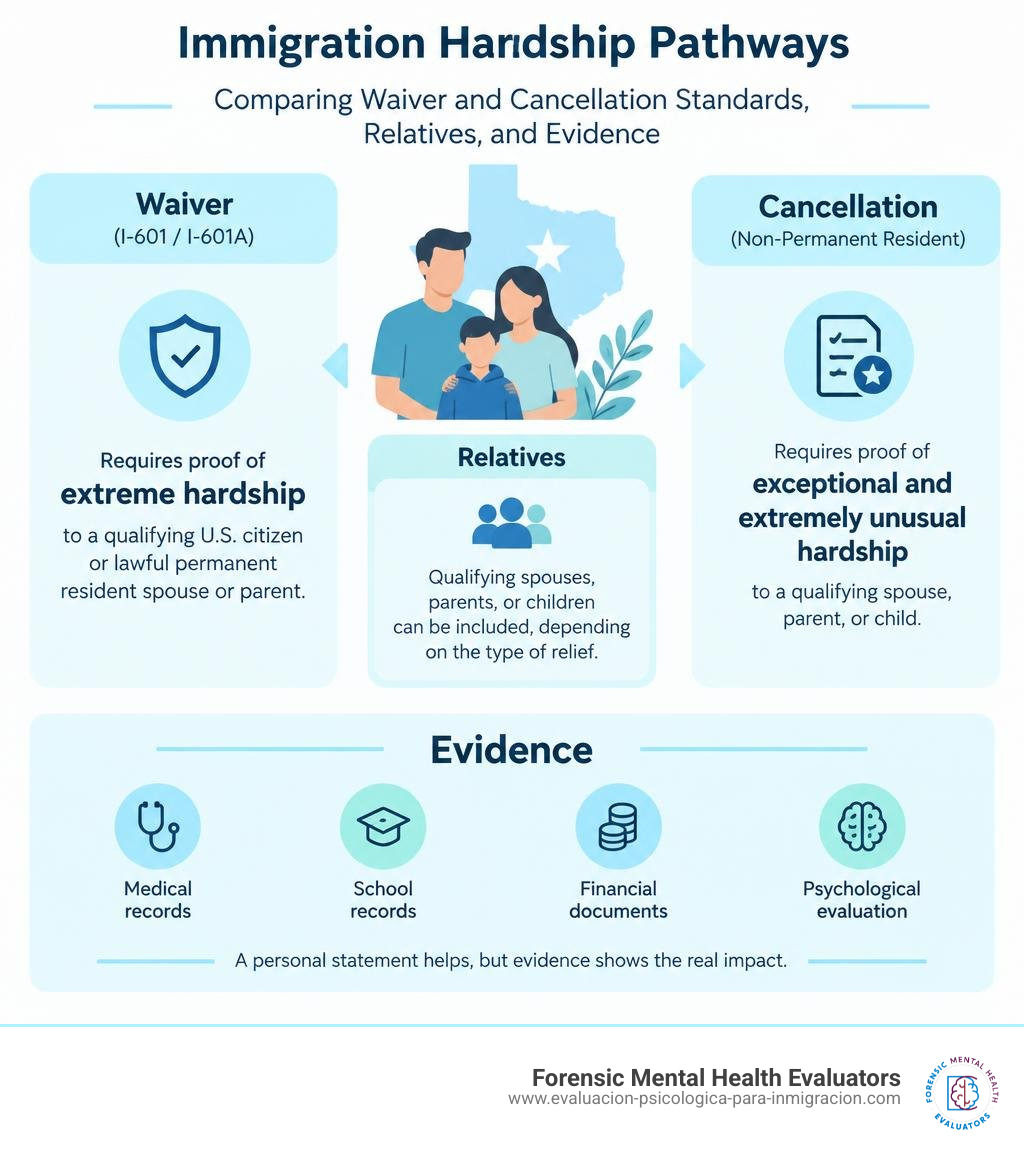
Start with the legal standard for your case. An I-601 or I-601A waiver generally requires proof of extreme hardship to a qualifying U.S. citizen or lawful permanent resident spouse or parent. If you face removal and seek non-permanent resident cancellation of removal, you must meet the higher exceptional and extremely unusual hardship standard for a qualifying spouse, parent, or child.
In either case, a personal statement alone may not be enough. Gather records that show who would be harmed, how severely, and why. Medical and school records, financial documents, and a psychological evaluation can help explain the effects of separation or relocation. An immigration attorney can identify which relief you may qualify for and which family members count under that law.
I'm Francisco Ortiz, a Texas-licensed forensic mental health evaluator whose work on immigration hardship texas cases focuses on documenting the psychological effects of family separation. I conduct evaluations for hardship waivers and immigration court proceedings, helping families present clear, evidence-based findings.
Legal Standards for Immigration Hardship Texas: Extreme vs. Exceptional
Proving hardship in immigration proceedings is rarely as simple as telling an adjudicator that family separation hurts. United States immigration law operates under the principle that some degree of emotional strain and financial adjustment naturally follows deportation. To win legal relief, applicants must demonstrate that their family's suffering reaches specific statutory thresholds defined by federal statutes, administrative guidance, and binding judicial precedents.
The governing framework for family-based waivers is outlined in the Chapter 5 - Extreme Hardship Considerations and Factors policy manual published by USCIS. Under federal law, hardship is evaluated through distinct legal standards depending on the application being pursued:
| Feature | Extreme Hardship (Waivers) | Exceptional & Extremely Unusual Hardship (Cancellation of Removal) |
|---|---|---|
| Primary Form | Form I-601 / Form I-601A | EOIR-42B Application |
| Legal Threshold | Hardship significantly beyond common consequences of separation | Severe, truly exceptional suffering far above ordinary hardship |
| Statutory Authority | INA § 212(a)(9)(B)(v), INA § 212(h), INA § 212(i) | INA § 240A(b)(1)(D) (8 U.S.C. § 1229b(b)(1)) |
| Qualifying Relatives | U.S. citizen or LPR spouse or parent (children excluded) | U.S. citizen or LPR spouse, parent, or unmarried child under 21 |
| Adjudicating Body | USCIS / U.S. Consular Posts | Executive Office for Immigration Review (EOIR) Courts |
| Required Proof | Cumulative medical, financial, emotional, and social hardship | Catastrophic medical needs, unmanageable educational deficits, severe trauma |
Understanding Extreme Hardship in Texas Waivers
For individuals subject to the three-year or ten-year unlawful presence bars, an extreme hardship waiver guide 2026 explains that applicants must file Form I-601 or Form I-601A (Provisional Unlawful Presence Waiver). The critical distinction in standard waiver cases is who qualifies. Under INA § 212(a)(9)(B)(v), only a U.S. citizen (USC) or lawful permanent resident (LPR) spouse or parent serves as a qualifying relative. Children are not statutory qualifying relatives for these unlawful presence waivers, though the direct impact on children can be evaluated indirectly through the psychological and financial toll it places on the qualifying spouse or parent.
As detailed when USCIS clarifies guidance on "extreme hardship", USCIS uses a totality-of-the-circumstances test. Applicants must show hardship under two scenarios:
- Relocation Hardship: The qualifying relative would suffer extreme hardship if they left the United States to accompany the applicant abroad.
- Separation Hardship: The qualifying relative would suffer extreme hardship if they remained in the United States while the applicant was excluded abroad.
Reviewing a 601 waiver hardship letter sample and knowing how to show extreme hardship for a waiver reveals that combining economic, psychological, and medical evidence creates a compelling cumulative argument.
Exceptional and Extremely Unusual Hardship in Removal Proceedings
When an individual without legal status is placed in deportation proceedings before an immigration judge, relief may be sought using the EOIR 42B form. Under a comprehensive cancellation of removal complete guide, this defensive form of relief allows non-permanent residents to adjust status to lawful permanent residency if they meet rigorous statutory bars:
- Continuous physical presence in the United States for at least 10 years immediately preceding the receipt of a Notice to Appear (NTA). The service of an NTA halts the continuous presence clock under the "stop-time" rule.
- Established good moral character during the entire 10-year statutory period.
- Absence of disqualifying criminal offenses under immigration statutes.
- Direct proof that removal would cause extreme and exceptionally unusual hardship to a qualifying relative.
As documented in materials understanding non-legal permanent resident cancellation of removal, qualifying relatives in cancellation proceedings include a USC or LPR spouse, parent, or unmarried child under the age of 21. Unlike standard I-601 waivers, children are direct qualifying relatives under EOIR-42B. However, the hardship standard is significantly higher: the suffering must be substantially beyond that which would ordinarily accompany the deportation of a close family member.
Fifth Circuit Precedent: The Impact of Trejo v. Garland
Immigration courts in Texas operate within the federal jurisdiction of the United States Court of Appeals for the Fifth Circuit. In the foundational precedent Trejo v. Garland (3 F.4th 760 (5th Cir. 2021)), the Fifth Circuit ruled on how hardship determinations must be reviewed.
The court held that whether established historical facts satisfy the statutory standard of "exceptional and extremely unusual hardship" is a question of law subject to judicial review, rather than an unreviewable matter of pure administrative discretion. However, the substantive outcome in Trejo illustrates the high evidentiary bar in Texas. In that case, the petitioner had resided in the U.S. for over 16 years, earned steady income as a cook, and supported three U.S. citizen children, including an eldest daughter diagnosed with Attention-Deficit/Hyperactivity Disorder (ADHD).
The Fifth Circuit affirmed the Board of Immigration Appeals (BIA) denial, determining that because the child's ADHD was stabilized through medication covered by Texas Medicaid and did not cause profound, long-term developmental disruption, it did not meet the statutory threshold of exceptional and extremely unusual hardship. The court noted that extended family members in the U.S. could assist with care. This precedent establishes that chronic or routine medical conditions alone—without robust documentation of severe clinical distress, treatment unavailability abroad, or irreversible cognitive decline—are insufficient in Texas immigration courts.
Types of Immigration Relief and Hardship Applications in Texas
Texas families navigate immigration relief across various stages of the legal process. Understanding the options can protect family unity and avoid the traumatic effects of family separation due to deportation.

Family-Based Waivers and Humanitarian Protections
Beyond defensive litigation in court, several affirmative hardship and humanitarian avenues allow individuals in Texas to secure lawful status:
- Provisional Waivers (Form I-601A): Allows eligible immediate relatives of U.S. citizens and lawful permanent residents to apply for an unlawful presence waiver within the United States before departing for their immigrant visa interview at a U.S. consulate abroad.
- Violence Against Women Act: Provides immigration relief for abused spouses, children, or parents of U.S. citizens or LPRs without relying on their abusive family member to sponsor them.
- Victims of Crime and Trafficking Protections: Detailed in the U Visa complete guide 2026, victims of qualifying crimes who assist law enforcement can secure lawful status. The statutory cap for U-visas remains at 10,000 principal visas per fiscal year. Similarly, the T Visa program offers protection for survivors of human trafficking.
- Deferred Action for Childhood Arrivals (DACA) and Temporary Protected Status (TPS): Specific administrative forms of temporary relief protecting individuals from deportation based on long-term physical presence or dangerous conditions in their home countries.
- Emergency Stay of Removal (Form I-246): For individuals with immediate orders of removal, filing Form I-246 with the local ICE Field Office alongside the $155 filing fee allows applicants to request a discretionary temporary stay of removal, granted in increments ranging from three months up to one full year.
- Voluntary Departure: Under INA § 240B, individuals who do not qualify for other relief may request voluntary departure, granting 60 to 120 days to leave the country voluntarily, avoiding the severe ten-year bar associated with formal deportation orders.
Non-LPR Cancellation of Removal Defense
Individuals facing active removal proceedings in Texas immigration courts (such as the courts in Houston, Dallas, San Antonio, Conroe, and El Paso) must present defensive arguments. Securing a formal cancellation of removal psych eval is often central to substantiating the claim before an immigration judge. Given the nationwide statutory cap of 4,000 non-LPR cancellation adjustments per year, cases move through an extensive docket, as outlined in the cancellation removal backlog guide 2026. Cases require meticulous preparation to ensure all medical, psychological, and financial documentation remains current throughout long court continuances.
Economic Hardship Employment for F-1 Students in Texas
Hardship is not exclusive to deportation defense; international students at Texas universities also encounter economic hardship provisions. F-1 students who experience severe, unforeseen financial distress may apply for off-campus work authorization through USCIS under the Severe Economic Hardship (SEH) program.
To qualify, an F-1 student must satisfy specific requirements:
- Continuous lawful F-1 status for at least one full academic year (nine consecutive months).
- Good academic standing as verified by their university.
- Demonstration that on-campus employment opportunities are unavailable or insufficient to meet the financial gap.
- Definitive documentary proof that the financial hardship stems from unforeseen circumstances beyond the student's control—such as sudden loss of financial aid or on-campus employment through budget cuts, severe currency devaluation in their home country, steep tuition spikes, or catastrophic medical expenses incurred by primary financial sponsors.
Once recommended by the university's Designated School Official (DSO) in the SEVIS system, the student files Form I-765 with USCIS. Approved students receive an Employment Authorization Document (EAD) valid for up to one year at a time, permitting off-campus work capped at 20 hours per week while academic semesters are in session and full-time hours during official holiday breaks. USCIS processing for economic hardship EAD applications routinely takes 90 days or longer, making early preparation essential.
State-Level Challenges: Texas Senate Bill 4 and Local Enforcement
The legal climate in Texas involves heightened interaction between state law enforcement and federal immigration frameworks. A prominent example is Texas Senate Bill 4 (SB 4). As tracked when civil rights organizations sue to block Texas from enacting extremist immigration law, SB 4 seeks to empower state and local police officers to arrest and detain individuals suspected of entering Texas without federal authorization. The statute also permits state magistrate judges to issue state-level removal orders.
Legal challenges argue that SB 4 violates the Supremacy Clause of the United States Constitution, which reserves immigration enforcement and deportation authority exclusively to the federal government.
Beyond legal challenges to state statutes, state policies directly affect how immigrant families access daily services. Inquiries into the potential impacts of new requirements in Florida and Texas for hospitals to request patient immigration status reveal increased fear among mixed-status families when seeking necessary medical care. As major metropolitan areas adapt and after crisis of unprecedented migrant arrivals, U.S. cities settle into new normal, these enforcement dynamics place immense psychological pressure on undocumented residents and their U.S. citizen relatives.
How to Document and Win an Immigration Hardship Texas Claim
Winning a hardship claim in Texas requires presenting clear, corroborated evidence. Adjudicators evaluate cases using the cumulative hardship doctrine: while individual hardship factors (such as mild financial loss or normal sadness) may not meet statutory thresholds on their own, multiple moderate hardship factors combined can establish the required legal standard.
Following the principles detailed in the immigration psychological assessment guide 2026, every claim must be supported by third-party documentation rather than self-serving affidavits alone. A comprehensive psychological report translates internal family distress into objective clinical data.
Core Categories of Hardship Evidence
A strong evidentiary filing should assemble documentation across five core categories:
- Comprehensive Psychological Records: Thorough mental health evaluations documenting the diagnostic impact of family separation or country relocation, addressing conditions such as family separation trauma, Major Depressive Disorder, and Panic Disorder.
- Medical and Diagnostic Evidence: Complete medical records from licensed physicians outlining chronic or life-threatening physical conditions affecting qualifying relatives (e.g., severe cardiovascular disease, juvenile diabetes, oncological treatments), including documentation of medical infrastructure shortages in the home country.
- Specialized Educational Documentation: School records, Individualized Education Programs (IEPs), 504 accommodation plans, and evaluations from speech or occupational therapists proving that a child has specialized learning needs that cannot be met abroad.
- Financial and Economic Records: Tax returns, mortgage statements, business records, debt obligations, and detailed household budget calculations demonstrating that the qualifying relative cannot maintain household stability alone or support two separate households across international borders.
- Country Condition Reports and Travel Advisories: Up-to-date reports from the U.S. Department of State, Amnesty International, and local news publications showing severe violence, medical shortages, or lack of critical social infrastructure in the specific town or region of proposed relocation.
Role of Psychological Evaluations in Proving Hardship
When presenting hardship before USCIS or an immigration court, working with a qualified Texas immigration psychological expert is often one of the most effective ways to substantiate psychological suffering. An evaluation conducted by a licensed clinician provides objective diagnostic evidence that elevates a claim beyond standard personal statements.
A thorough clinical evaluation conducts structured clinical interviews and utilizes standardized psychometric testing (such as the PHQ-9, GAD-7, PCL-5, and MMPI) to assess for clinical diagnoses, including:
- Post-Traumatic Stress Disorder (PTSD) resulting from past trauma or continuous fear of family rupture.
- Major Depressive Disorder with severe functional impairment.
- Generalized Anxiety Disorder and Panic Disorder tied directly to the prospect of deportation or relocation.
A specialized trauma evaluation immigration report explains how the qualifying relative's baseline functioning will deteriorate without the applicant's daily presence. For Spanish-speaking families across Texas, working with a bilingual psychologist immigration eval specialist ensures that nuanced emotional expressions and cultural factors are accurately evaluated and clearly translated for immigration adjudicators.
Frequently Asked Questions About Immigration Hardship Texas
What is the difference between extreme hardship and exceptional and extremely unusual hardship?
The primary difference lies in the severity threshold and the qualifying relatives involved. Extreme hardship applies to Form I-601 and I-601A waivers and requires showing hardship to a U.S. citizen or LPR spouse or parent that goes significantly beyond the ordinary difficulties of deportation. Exceptional and extremely unusual hardship applies to defensive non-LPR cancellation of removal (EOIR-42B) in immigration court. This higher standard requires showing truly severe suffering to a USC or LPR spouse, parent, or child under 21, demonstrating hardship far above that experienced in typical deportation cases.
Can an F-1 international student apply for off-campus work due to economic hardship in Texas?
Yes. An F-1 student who has maintained lawful academic status for at least one full academic year can apply for Severe Economic Hardship (SEH) employment authorization via Form I-765. The student must prove to USCIS that unexpected, severe financial circumstances beyond their control (such as currency collapse, sponsor medical emergencies, or loss of on-campus employment) have placed their education in jeopardy and that on-campus employment is unavailable.
How does the Fifth Circuit ruling in Trejo v. Garland affect Texas cancellation of removal cases?
The Fifth Circuit's ruling in Trejo v. Garland established that whether facts meet the legal threshold for exceptional and extremely unusual hardship is a question of law open to appellate review. However, it also set a strict precedent: common childhood conditions such as ADHD, when managed through state-funded programs like Texas Medicaid without severe developmental decline, do not satisfy the statutory threshold for cancellation of removal. Claimants must provide comprehensive medical, educational, and psychological evidence proving profound, irreversible harm.
Conclusion
Proving hardship in Texas immigration cases requires thorough legal and psychological documentation. Whether you are filing an affirmative I-601A waiver or defending against deportation in immigration court, demonstrating the full scope of your family's emotional, medical, and financial realities is essential.
At District Counseling, we provide thorough, bilingual psychological evaluations tailored to immigration cases across Texas, including Houston, Katy, Cypress, Sugar Land, Austin, Dallas, and San Antonio, as well as telehealth evaluations for clients across Texas, Florida, California, New York, Utah, Virginia, and Idaho. Our clinical evaluations are conducted directly in Spanish and delivered as translated English reports formatted for USCIS officers and immigration judges. To support our clients' ongoing well-being throughout this challenging legal process, we also provide six free supportive therapy sessions following report completion.
If your family is preparing a hardship waiver or cancellation case, learn more about our specialized evaluacion psicologica para caso de una cancelacion de deportacion services to ensure your hardship case is backed by clinical evidence.