
Understanding Family Separation Trauma: Stages and Compounding Factors

When children are forcibly separated from their primary caregivers, the disruption cuts far deeper than temporary distress. It dismantles the primary relational foundation that young human beings rely on to regulate their nervous systems, interpret safety, and explore their environment. In the context of international migration and border enforcement, this rupture rarely happens in a vacuum. Instead, it operates as a catastrophic multiplier within an ongoing trajectory of cumulative adversity.
Asylum-seeking and migrant families typically arrive at international borders carrying acute pre-migration distress, including community violence, gang extortion, persecution, and the severe physical stressors of migration journeys. When government policies mandate the physical removal of a child from a parent upon arrival, this protective buffer disappears. Parents experience overwhelming helplessness, disorientation, and existential terror regarding their child’s location and safety, while children experience an abrupt, incomprehensible loss of protection.
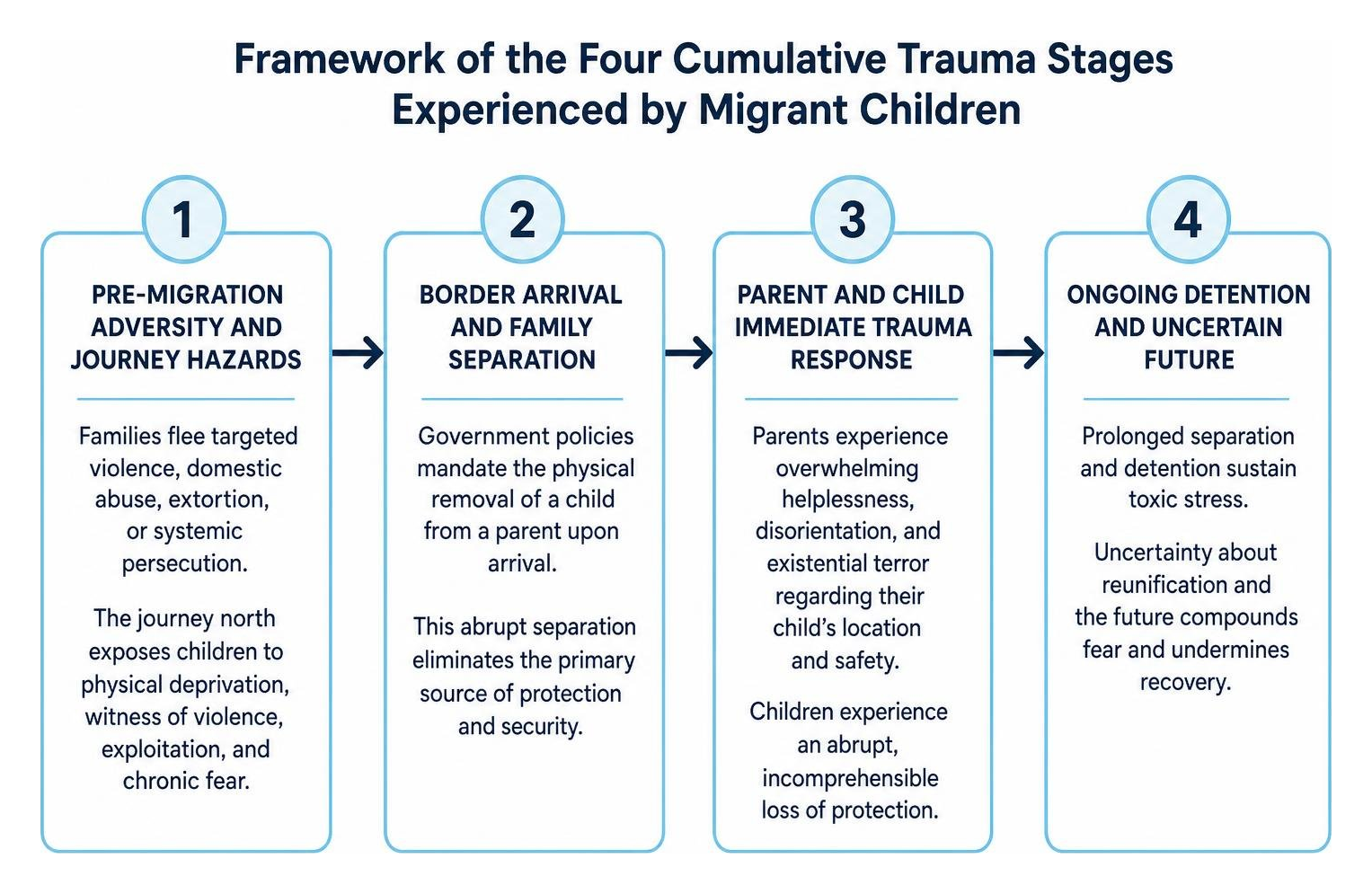
The Four Traumatic Stages of Migrant Family Separation Trauma
Migrant children affected by hardline border enforcement navigate four distinct, compounding traumatic stages that layer stress upon the developing nervous system:
- Pre-Migration Adversity and Journey Hazards: Families flee targeted violence, domestic abuse, extortion, or systemic persecution in their home countries. The journey north exposes children to physical deprivation, witness of violence, exploitation, and chronic fear.
- The Forced Separation Event: Children are physically removed from their parents by armed authorities, often without explanation, advance notice, or the opportunity to say goodbye. This abrupt attachment rupture strips the child of their primary coping resource.
- Immigration Detention: Unaccompanied minors are processed and held in institutional immigration detention facilities, often under austere conditions, separated from siblings and familiar support figures.
- Foster Placement or Institutional Shelters: Placed into temporary foster homes, group shelters, or child welfare institutions, children face unfamiliar linguistic, cultural, and environmental landscapes while carrying the unresolved grief of separation.
Documenting these layered experiences requires specialized clinical assessments. Conducting a detailed trauma evaluation for immigration allows forensic clinicians to map how each discrete stage compounds overall distress, providing essential documentation for legal cases.
Detention Facility Conditions and Placement Instability
The physical environment of initial detention dramatically worsens the acute trauma of separation. Children and parents are frequently held in short-term border facilities—colloquially referred to as hieleras (iceboxes) due to freezing temperatures—featuring cement floors, continuous overhead fluorescent lighting, open sanitary facilities, and severe overcrowding. Children have reported sleeping beneath thermal mylar sheets in chain-link enclosures, stripped of personal belongings, and left without clear communication regarding their parents' whereabouts.
Prolonged stays in these institutional environments amplify psychological harm. Research consistently demonstrates that the longer children remain in detention facilities, the steeper their mental health deterioration becomes.
When transferred to the Office of Refugee Resettlement (ORR) shelter network or temporary foster care arrangements, children frequently encounter placement instability. Behavioral manifestations of trauma—such as sudden emotional outbursts, profound withdrawal, nocturnal enuresis, and attachment defiance—can strain foster placements. Nationally, approximately one-fifth of foster care placement alterations stem directly from a child's unaddressed trauma-related behavioral challenges. Each subsequent move reinforces the child's perception of abandonment, deepening psychological distress, as documented in extensive scientific research on childhood trauma and border separation (Teicher, 2018).
Neurobiological and Physical Health Consequences
The human body does not process attachment disruption merely as an emotional event; it registers the sudden absence of a primary caregiver as an existential threat to survival. In early childhood, parental presence acts as an external neurobiological regulator. When that bond is severed under coercive conditions, the neuroendocrine architecture undergoes severe alterations.
Neurodevelopment and Epigenetic Stress Responses
During sensitive developmental windows—particularly throughout the first seven years of life—the brain relies on safe, predictable interactions to wire neural circuits governing stress reactivity, affect regulation, and executive functioning. The sudden removal of a parent triggers a surge of toxic stress, flooding the central nervous system with catecholamines and glucocorticoids.
This sustained activation of the hypothalamic-pituitary-adrenal (HPA) axis generates profound structural and functional changes across key corticolimbic structures:
- Amygdala Hyperactivity: Chronic stress induces architectural remodeling in the basolateral amygdala, heightening vigilance and locking the child into a persistent state of fight, flight, or freeze.
- Hippocampal Volume Reduction: Elevated cortisol levels inhibit neurogenesis and induce dendritic atrophy in the hippocampus, impairing contextual memory encoding, learning, and the capacity to distinguish between past trauma and present safety.
- Prefrontal Cortex Dysregulation: Disruptions in medial prefrontal connectivity weaken top-down inhibitory control over subcortical fear circuits, undermining emotional self-regulation, impulse control, and executive processing.
Emerging research also highlights the epigenetic consequences of severe childhood adversity. Toxic stress can alter DNA methylation patterns in genes regulating glucocorticoid receptors (such as NR3C1). These biological adaptations not only heighten lifetime vulnerability to mood and anxiety disorders but can also be passed down intergenerationally, shaping stress reactivity in subsequent generations.
Somatic Morbidity and Chronic Health Risks
Trauma manifests throughout the entire body. Pediatricians evaluating separated children frequently encounter somatic presentations with no clear organic etiology, including chronic abdominal cramping, tension headaches, and localized chest pain. As clinical observers have recorded, young children often express their emotional agony in physical terms, describing sensations like "every heartbeat hurts" or feeling as if their heart has physically shut down.
In the long term, sustained allostatic load degrades immune competence. Chronic activation of pro-inflammatory pathways elevates baseline C-reactive protein (CRP) and pro-inflammatory cytokines, increasing susceptibility to infectious diseases, asthma exacerbations, and pediatric developmental regression.
Decades of public health data establish that severe early childhood adversity significantly elevates the adult risk profile for chronic medical conditions, including:
- Metabolic disorders and Type 2 diabetes
- Cardiovascular disease and hypertension
- Autoimmune conditions and chronic inflammatory states
- Chronic obstructive pulmonary disease (COPD)
Understanding these lifelong physical trajectories is central to evaluating the broader effects of family separation due to deportation, where the abrupt loss of household stability creates cascading psychological and physical consequences for developing children.
Psychological Impacts on Children and Parents Across Timelines
The psychiatric burden carried by separated families is severe, pervasive, and persistent across multiple years. Clinical documentation shows that family separation systematically produces clinical-grade psychiatric disorders across both generations.
Clinical Diagnoses Documented in Separated Children and Parents
Children subjected to border separation exhibit markedly higher rates of emotional and behavioral disturbances compared to their non-separated peers. In controlled comparative evaluations within detention environments, 49% of separated children demonstrated significant emotional problems, compared to 29% of non-separated migrant children, alongside significantly elevated total difficulties scores (15% vs. 9%).
In qualitative and quantitative medico-legal analyses, including peer-reviewed investigations published in PLOS ONE on forced family separation (Hampton et al., 2021), clinicians routinely document high rates of psychiatric comorbidities:
- Post-Traumatic Stress Disorder (PTSD): Clinicians identify persistent intrusive re-experiencing, hyperarousal, night terrors, and avoidance behavior in both parents and children.
- Major Depressive Disorder (MDD): Marked by persistent despair, psychomotor slowing, appetite disruption, severe anhedonia, and feelings of utter worthlessness.
- Separation Anxiety Disorder: In children, this manifests as extreme distress upon even brief physical separations, school refusal, and chronic fear that caregivers will vanish.
- Generalized Anxiety Disorder (GAD): Constant, uncontrollable worry regarding legal stability, family safety, and impending re-separation.
- Suicidal Ideation: The psychological agony of separation drives severe despair; clinical evaluations have documented that multiple separated parents experienced acute suicidal ideation while isolated from their children.
Clinicians performing forensic evaluations consistently observe that these trauma presentations reflect authentic, profound psychological distress, with no evidence of symptom exaggeration or malingering.
Post-Reunification Symptoms and Persistent Distress
A critical misconception regarding family separation is the assumption that physical reunification serves as an immediate cure. While bringing families back together is the necessary first step toward recovery, reunification marks the beginning of an arduous, complex psychological rehabilitation process.
Longitudinal evidence shows that trauma symptoms endure across multi-year post-reunification timelines:
- A six-year-old child evaluated one year post-reunification continued to meet full DSM diagnostic criteria for PTSD, experiencing recurrent nightmares, behavioral regression, and severe emotional detachment.
- An eight-year-old child assessed two years after reunification remained clinically impaired by both PTSD and severe separation anxiety disorder.
- Longitudinal investigations, such as the landmark PHR report on long-term parental trauma, demonstrate that parents continue to meet clinical criteria for PTSD, major depression, and panic attacks three to four years after being separated by government authorities.
Parents often describe the separation as an enduring, visceral wound—a feeling of having part of their physical and emotional self torn away. Post-reunification households frequently grapple with attachment ambivalence, where children alternate between intense, anxious clinging and episodes of withdrawal or anger directed at the parent for having "abandoned" them.
Legal, Policy, and Human Rights Frameworks
The systematic separation of families at international borders represents an intersection of administrative immigration law, domestic child welfare mandates, and international human rights treaties.
Evolution of Federal Enforcement and Border Policies
Between 2017 and 2018, the United States government implemented the "Zero Tolerance" immigration policy. Under this directive, all adult migrants crossing the southern border without prior authorization were referred for criminal prosecution under 8 U.S.C. § 1325. Because children cannot legally be held in criminal detention facilities alongside parents undergoing criminal proceedings, federal agencies classified these children as "unaccompanied minors," transferring them to ORR custody while their parents were placed into federal detention or processed for deportation.
This administrative mechanism resulted in the forced separation of more than 5,000 children from their parents. More than 2,300 children—averaging roughly 65 children per day—were removed from their families during the initial peak rollout. In response to widespread domestic and international condemnation, executive orders and subsequent federal court injunctions (such as Ms. L. v. ICE) halted blanket separations and established interagency task forces to identify and reunite separated children.
However, systemic identification challenges, inadequate government tracking data, and the prior deportation of parents without their children left at least 1,841 children un-reunited years after policy termination.
| Policy Period / Administration | Primary Operational Strategy | Child Welfare & Separation Impact | Long-Term Psychological & Legal Trajectory |
|---|---|---|---|
| Zero Tolerance Policy Era (2017–2018) | Universal criminal prosecution of adult border crossers under 8 U.S.C. § 1325; automatic reclassification of accompanied children as unaccompanied. | Over 5,000 children forcibly separated; acute institutional detention in border facilities (hieleras); rapid parent deportations without tracking. | Severe, persistent rates of clinical PTSD, Major Depression, and attachment rupture in both children and parents. |
| Federal Court Injunctions & Post-Zero Tolerance (2018–2020) | Court-mandated halts (Ms. L. v. ICE); case-by-case separations based on alleged parental unfitness or criminal history; initial reunification efforts. | Widespread tracking failures; hundreds of deported parents untraceable; ongoing shelter stays for hundreds of separated minors. | Prolonged family ambiguity; development of complex, chronic grief; increased risk of behavioral and somatic regressions. |
| Interagency Task Force Era (2021–Present / 2026) | Formal federal task force established to locate, identify, and process reunifications; humanitarian parole granted for reunification within the U.S. | Over 3,000 reunifications facilitated; ongoing identification of remaining separated children and fragmented family units. | High requirement for specialized trauma-focused mental health interventions, medico-legal assessments, and status regularizations. |
Comprehensive forensic documentation is vital for families navigating complex immigration court dockets. Legal representatives frequently rely on an immigration psychological evaluation guide to understand how clinical findings integrate into legal proceedings.
Human Rights Violations, Torture Standards, and Reparations
Medical, legal, and human rights organizations have evaluated family separation policies against binding international frameworks, including the United Nations Convention Against Torture and Other Cruel, Inhuman or Degrading Treatment or Punishment (CAT).
Under international law, torture is defined by four core elements:
- The intentional infliction of severe physical or mental pain and suffering;
- Inflicted by, at the instigation of, or with the consent/acquiescence of a public official;
- For a specific purpose, such as coercion, punishment, intimidation, or deterrence;
- Outside the scope of lawful sanctions.
Legal and psychiatric scholars conclude that when forced separation is utilized deliberately to deter future asylum seekers through the intentional infliction of severe psychological suffering, the practice meets the established legal definition of torture, or at minimum constitutes cruel, inhuman, and degrading treatment.
Under international human rights standards, victims of state-sanctioned torture are entitled to full redress and reparations. Separated parents and advocacy organizations have called for comprehensive reparative frameworks, including:
- Formal, public apologies by state authorities acknowledging systemic harm;
- Comprehensive independent investigations and truth commissions;
- Dedicated federal funding for long-term psychological rehabilitation;
- Permanent lawful immigration status in the United States to guarantee family unity and stability;
- Direct compensatory restitution for physical and psychological harms endured.
Rigorous psychiatric evaluation remains crucial for establishing the medico-legal basis for these claims, as outlined in our asylum psychological assessment complete guide.
Clinical, Educational, and Community Healing Pathways
Reversing the harms of forced separation requires comprehensive, multi-tiered interventions across clinical, educational, and community domains.
Evidence-Based Healing for Family Separation Trauma
Clinical treatment for reunited families must address the complex intersection of attachment rupture, developmental regression, and systemic stress. Standard psychotherapy approaches are frequently insufficient without integrating trauma-informed, culturally responsive modalities:
- Child-Parent Psychotherapy (CPP): Designed specifically for young children (ages 0–5) and their primary caregivers, CPP focuses on repairing the attachment bond, restoring parental self-efficacy, and helping the dyad construct a coherent joint narrative of the separation event.
- Trauma-Focused Cognitive Behavioral Therapy (TF-CBT): Highly effective for school-aged children and adolescents, TF-CBT incorporates psychoeducation, emotional regulation training, cognitive processing, and gradual trauma narrative development in close collaboration with the reunited caregiver.
- Somatic and Body-Oriented Therapies: Because traumatic stress alters autonomic nervous system functioning, modalities incorporating somatic experiencing, gentle movement, and grounding help patients release physiological tension and process somatic distress.
- Bilingual and Culturally Competent Care: Interventions must be delivered in the family’s primary language (including indigenous languages where applicable) and respect cultural conceptualizations of distress and healing.
Beyond direct clinical care, trauma-informed accommodations within legal processes are essential. Immigration courts and asylum offices must provide procedural safeguards, including regular breaks during testimony, child-friendly forensic settings, simple and transparent language, and the presence of support professionals to prevent re-traumatization during removal defense and extreme hardship psychological evaluation proceedings.
School-Based Support and Community Resources
When migrant children enter public education systems, educators and school-based mental health professionals serve on the front lines of healing. Schools must be equipped with resources, staffing, and administrative protocols designed to support traumatized migrant students.

Key school-based protective strategies include:
- Implementing Trauma-Informed Classrooms: Creating predictable daily routines, establishing safe physical spaces within classrooms, and avoiding disciplinary practices (such as sudden isolation or physical restraint) that trigger trauma responses.
- Expanding Mental Health Staffing: Increasing the availability of bilingual school psychologists, social workers, and licensed counselors capable of recognizing trauma-induced somatic complaints and behavioral distress.
- Social-Emotional Learning (SEL): Integrating curriculum-wide emotional literacy, self-regulation skills, and peer empathy programs.
- Community Mutual Aid and Grassroots Support: Partnering with community-based advocacy groups, local health centers, and legal aid clinics to provide holistic support for the entire household, reflecting broader perspectives on weaponized trauma and community care.
Frequently Asked Questions About Family Separation Trauma
How long do psychological symptoms persist after family reunification?
Psychological symptoms typically endure for years following reunification if families do not receive specialized mental health care. Clinical studies demonstrate that children and parents frequently meet diagnostic criteria for PTSD, major depressive disorder, and separation anxiety two to four years after being reunited. Recovery depends heavily on placement stability, continuous access to trauma-focused psychotherapy, legal security, and the psychological health of the reunited parent.
Does forced family separation meet the legal definition of torture?
Leading medical, psychological, and human rights organizations argue that forced family separation meets the legal criteria for torture under the United Nations Convention Against Torture. When government actors intentionally inflict severe mental suffering by separating children from parents to deter future migration, this conduct fulfills the core legal definitions of state-sanctioned torture or cruel, inhuman, and degrading treatment.
What can foster caregivers and educators do to mitigate trauma symptoms?
Foster caregivers and educators can support healing by establishing predictable, transparent daily schedules, providing safe environments for emotional expression, and avoiding punitive responses to trauma-related behavioral outbursts. Caregivers should listen patiently without pressing for trauma details, validate the child's feelings of grief or confusion, provide physical affection only when initiated by the child, and coordinate closely with bilingual mental health professionals.
Conclusion
The forced separation of migrant children from their parents leaves deep, lasting neurobiological, psychological, and systemic wounds. Rebuilding security and health requires specialized clinical intervention, trauma-informed education, legal advocacy, and long-term community support.
At District Counseling, we provide culturally and linguistically responsive mental health evaluations for immigration proceedings, including asylum, U-Visas, and cancellation of removal cases. Serving communities across Texas—including Houston, Katy, Cypress, Sugar Land, Austin, Dallas, and San Antonio—as well as clients in Florida, California, New York, Utah, Virginia, and Idaho, our team delivers detailed Spanish-language psychological evaluations translated into English. To ensure continuity of healing, we provide six free therapy sessions post-report to support clients on their path to recovery.
For more information or to schedule an evaluation, explore our specialized services for evaluación psicológica para inmigración and begin the journey toward healing today.
References
Teicher MH. "Childhood trauma and the enduring consequences of forcibly separating children from parents at the United States border.." BMC medicine, 2018. PMCID PMC6103973. Hampton K, Raker E, Habbach H, Camaj Deda L, Heisler M, Mishori R. "The psychological effects of forced family separation on asylum-seeking children and parents at the US-Mexico border: A qualitative analysis of medico-legal documents.." PloS one, 2021. PMCID PMC8612557. Belau MH, Becher H, Kraemer A. "Impact of Family Separation on Subjective Time Pressure and Mental Health in Refugees from the Middle East and Africa Resettled in North Rhine-Westphalia, Germany: A Cross-Sectional Study.." International journal of environmental research and public health, 2021. PMCID PMC8582773.