
Who Qualifies for a T Visa?

T visa eligibility has five main requirements. You must have experienced a severe form of sex or labor trafficking, be in the United States because of that trafficking, comply with reasonable law enforcement requests unless an exception applies, and show that removal would cause extreme hardship involving unusual and severe harm. You must also be admissible to the United States or qualify for a waiver. Survivors under 18 and those unable to cooperate because of trauma may be excused from the law enforcement requirement.
Created in 2000 to protect trafficking survivors, T nonimmigrant status can allow an initial stay of up to four years and may lead to a green card. If you are facing removal, a pending T visa application does not automatically stop your immigration case, so getting legal advice quickly matters.
I am Francisco Ortiz, a certified forensic mental health evaluator whose work includes trauma and hardship assessments relevant to t visa eligibility. In this guide, I explain what USCIS looks for and where a psychological evaluation may help document a survivor's experience.
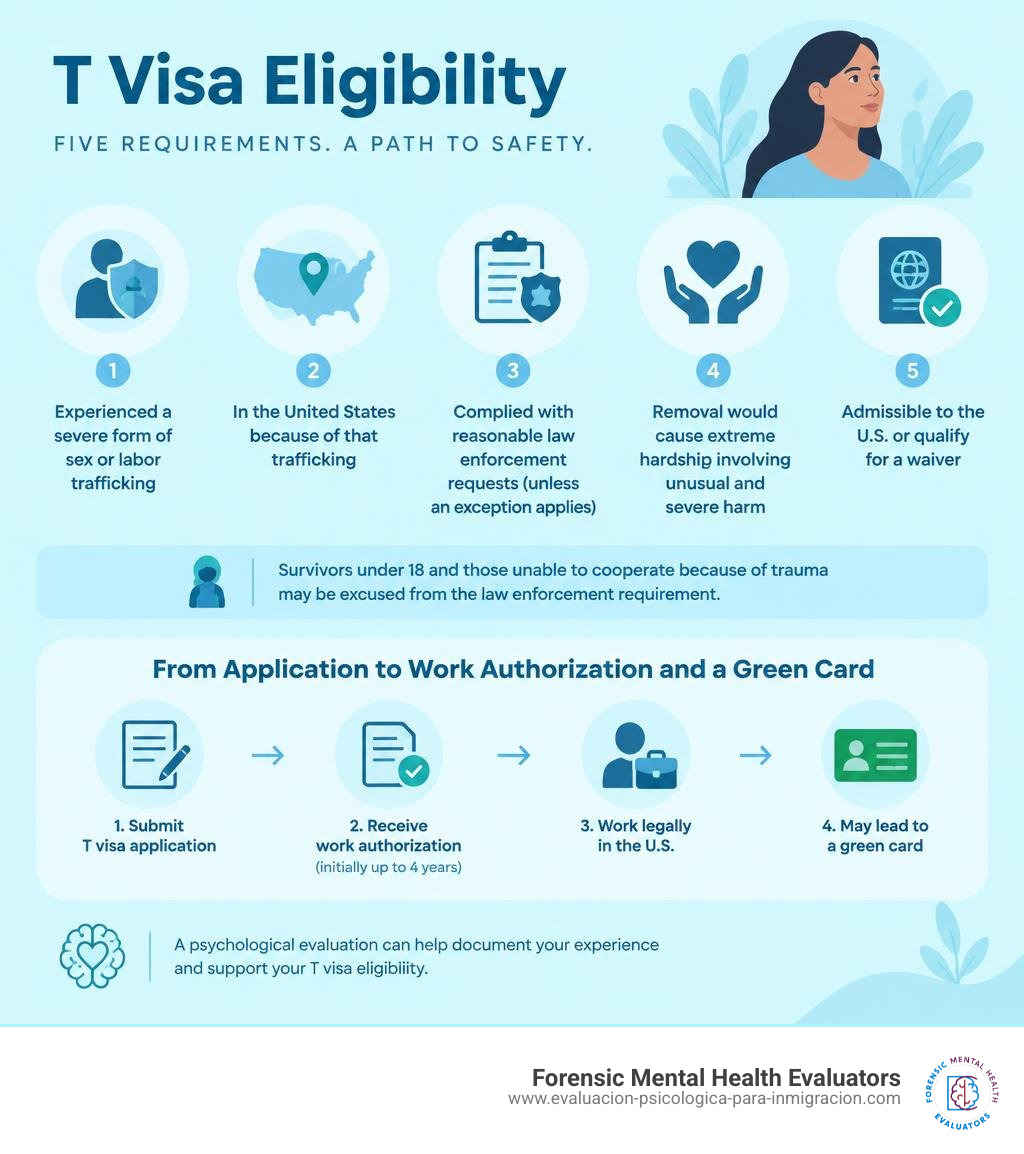
Core Statutory Criteria for T Visa Eligibility
Congress established T nonimmigrant status in October 2000 under the Victims of Trafficking and Violence Protection Act (TVPA). The benefit shields noncitizens who have endured severe forms of human exploitation. U.S. Citizenship and Immigration Services reviews these filings to provide relief for vulnerable survivors.
To qualify, an applicant must satisfy five core statutory prongs:
- Prove they are a victim of a severe form of trafficking in persons.
- Establish physical presence in the United States, American Samoa, the Commonwealth of the Northern Mariana Islands, or at a port of entry on account of trafficking.
- Comply with any reasonable request for assistance from law enforcement in the investigation or prosecution of the acts, unless exempt due to age or trauma.
- Demonstrate that removal from the United States would cause extreme hardship involving unusual and severe harm.
- Establish admissibility to the United States or obtain a waiver using Form I-192 for applicable inadmissibility grounds.
The statutory cap allows up to 5,000 principal T-1 visas each fiscal year, a threshold that has historically never been exhausted. For an overarching overview of this protective status, read our general guide to the T visa.
Severe Forms of Human Trafficking Under Federal Law
Federal law recognizes two distinct categories of human trafficking:
- Labor Trafficking: The recruitment, harboring, transportation, provision, or obtaining of a person for labor or services through the use of force, fraud, or coercion for the purpose of subjection to involuntary servitude, peonage, debt bondage, or slavery.
- Sex Trafficking: The recruitment, harboring, transportation, provision, obtaining, patronizing, or soliciting of a person for the purpose of a commercial sex act. When the survivor is an adult (age 18 or older), the act must involve force, fraud, or coercion. If the victim is under 18 years old, any commercial sex act is legally classified as a severe form of trafficking automatically—no showing of force, fraud, or coercion is required.
Physical Presence Requirements for T Visa Eligibility
Applicants must demonstrate that their physical presence in the United States is connected to the trafficking they endured. This nexus is established if the survivor:
- Was brought to the United States directly by the traffickers.
- Was liberated or escaped from trafficking conditions inside the United States.
- Maintained an unbroken presence in the country after escaping because ongoing trauma, fear, or practical hurdles prevented safe departure.
Even if some time has passed since escaping the exploitative environment, an applicant remains eligible if they can prove their continuous presence in the country directly relates to the original trafficking incident and its psychological aftermath.
Law Enforcement Cooperation and T Visa Eligibility Exceptions
Principal applicants aged 18 or older generally must cooperate with reasonable requests from investigating authorities, such as local police, federal agencies (FBI, HSI, DOL), or prosecutors. However, federal regulations provide critical safeguards:
- Minor Exemption: Survivors who were under 18 years old at the time of the trafficking are legally exempt from the requirement to assist law enforcement.
- Trauma Exception: Applicants who cannot cooperate due to physical or psychological trauma qualify for a statutory exemption.
A thorough clinical assessment, such as a specialized T Visa psych report, documents diagnostic conditions like Post-Traumatic Stress Disorder (PTSD), severe anxiety, or depression that prevent the survivor from retelling their story to investigators. Undergoing a clinical trauma evaluation for immigration ensures that USCIS adjudicators receive objective evidence explaining why interacting with law enforcement would cause severe psychological or physical harm.
Demonstrating Unusual and Severe Harm and Extreme Hardship
The legal standard for T nonimmigrant status requires showing "extreme hardship involving unusual and severe harm" upon removal. This standard exceeds standard economic or emotional difficulties. USCIS adjudicators evaluate:
- The availability of adequate physical and mental healthcare in the home country.
- The likelihood of re-trafficking or retaliatory violence by traffickers or their associates.
- Social stigma, ostracization, or lack of family protection in the country of origin.
- The survivor's age, physical health, and psychological vulnerability.
Submitting comprehensive clinical evidence prepared in accordance with our comprehensive immigration psychological evaluation guide helps establish how deportation would disrupt necessary psychiatric care and trigger severe psychological regression.
Essential Application Forms, Evidence, and Law Enforcement Certifications
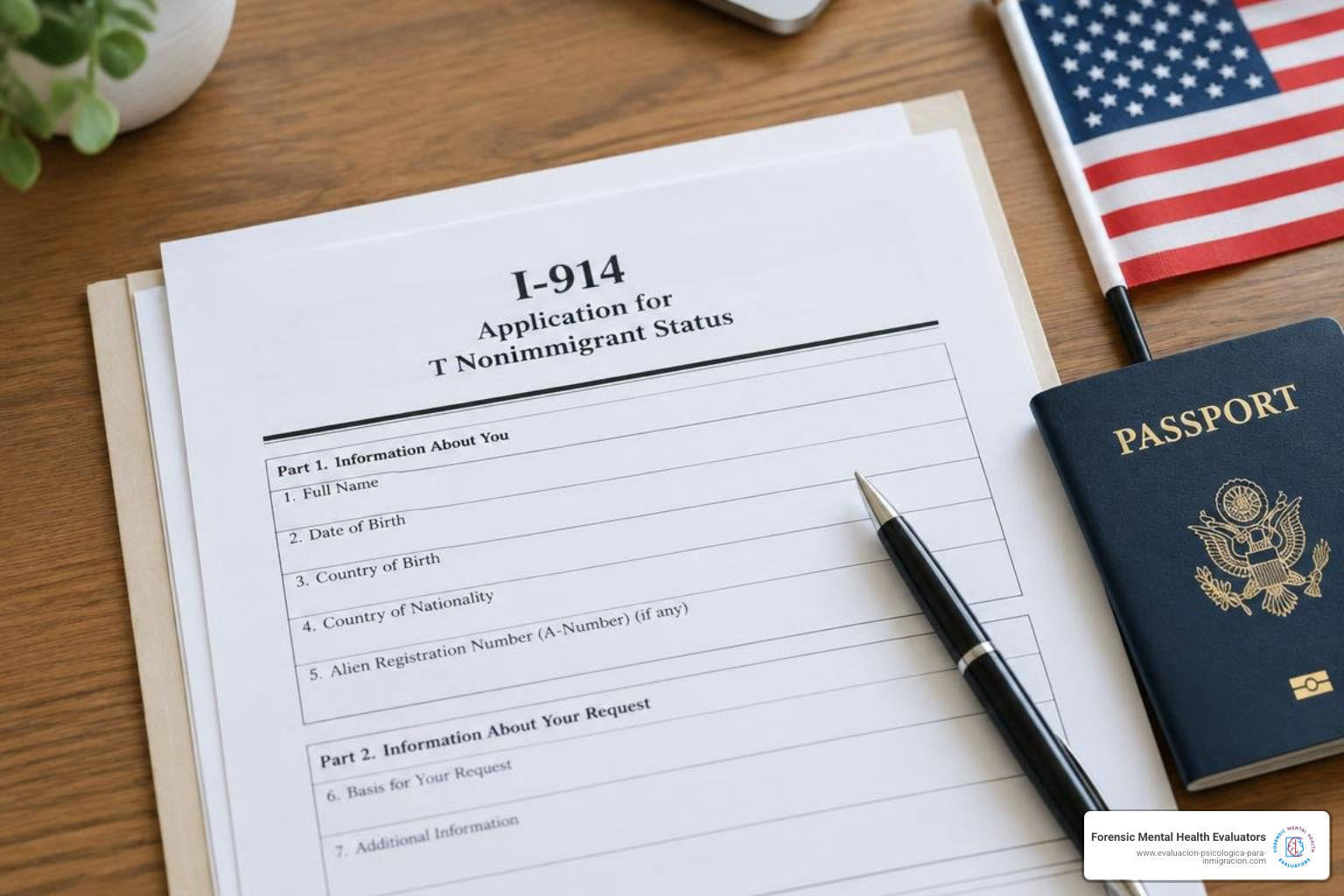
Applying for T nonimmigrant status involves submitting Form I-914 (Application for T Nonimmigrant Status) directly to the USCIS Vermont Service Center. Applicants must consult the official Form I-914, Instructions for Application for T Nonimmigrant Status before filing. Survivors are fee-exempt for the principal petition and related filings through adjustment of status. Review our guide on filing the I-914 form for practical instructions.
A complete filing package includes:
- Completed and signed Form I-914.
- A detailed, first-person sworn personal statement describing the trafficking, the means of coercion, the escape, and the ongoing trauma.
- Corroborating primary and secondary evidence (police reports, medical records, trial transcripts, work logs, threatening messages, or witness affidavits).
- Form I-192 (Application for Advance Permission to Enter as a Nonimmigrant) if any grounds of inadmissibility apply.
- Certified English translations for any foreign-language documentation.
Form I-914 Supplement B and Alternative Evidentiary Standards
Form I-914 Supplement B is a declaration of law enforcement cooperation completed by an investigating agency. While federal guidelines from the Immigrant Victims of Crime (U & T Visas) - Department of Labor and the TOOLKIT ADULT PROTECTIVE SERVICES highlight how agencies certify cooperation, Supplement B is not mandatory for a T visa.
If an agency refuses to sign or an investigation was never formally opened, survivors can satisfy the evidentiary burden through secondary records, such as hotline tip confirmations, personal statements, or mental health evaluations.
| Feature | Form I-914 Supplement B (T Visa) | Form I-918 Supplement B (U Visa) |
|---|---|---|
| Mandatory Requirement | No (Optional; secondary evidence accepted) | Yes (Mandatory prerequisite) |
| Certifying Agencies | Police, HSI, FBI, DOL, APS, Prosecutors, Judges | Police, Prosecutors, Judges, Child/Adult Protective Services |
| Age Exemption | Under 18 exempt from cooperation | All ages require certification |
| Trauma Exception | Formal statutory trauma waiver available | No statutory trauma exemption |
| Primary Focus | Assistance with human trafficking inquiries | Helpfulness in investigating qualifying crimes |
Confidentiality Protections and Safe Address Safeguards
Federal statute 8 U.S.C. § 1367 prohibits the Department of Homeland Security (DHS) from disclosing any information about a T visa applicant to third parties, including law enforcement executing civil immigration enforcement actions. Adjudicators cannot base adverse determinations on information provided solely by the trafficker.
Applicants can also provide a designated "safe mailing address" on Form I-914. USCIS sends all correspondence, receipt notices, and approval documents to this alternate address to keep abusive employers or traffickers from discovering the filing.
Derivative Status for Qualifying Family Members

Principal applicants (T-1) can petition for eligible relatives using Form I-914 Supplement A (Application for Derivative T Nonimmigrant Status), whether the family members reside in the United States or abroad.
Qualifying Family Categories: T-2 Through T-6
- T-2: Spouse of the principal applicant.
- T-3: Unmarried children under 21 years of age.
- T-4: Parents of a principal applicant who is under 21 years of age.
- T-5: Unmarried siblings under 18 years of age (if the principal is under 21).
- T-6: Adult or minor children of derivative family members (such as grandchildren of the principal) who face a present danger of retaliation due to the principal's escape or cooperation with law enforcement.
Derivative beneficiaries do not count toward the annual 5,000 statutory cap and receive age-out protections if petitions are properly lodged before qualifying age thresholds.
Bona Fide Determination, Work Permits, and Permanent Residency Pathways
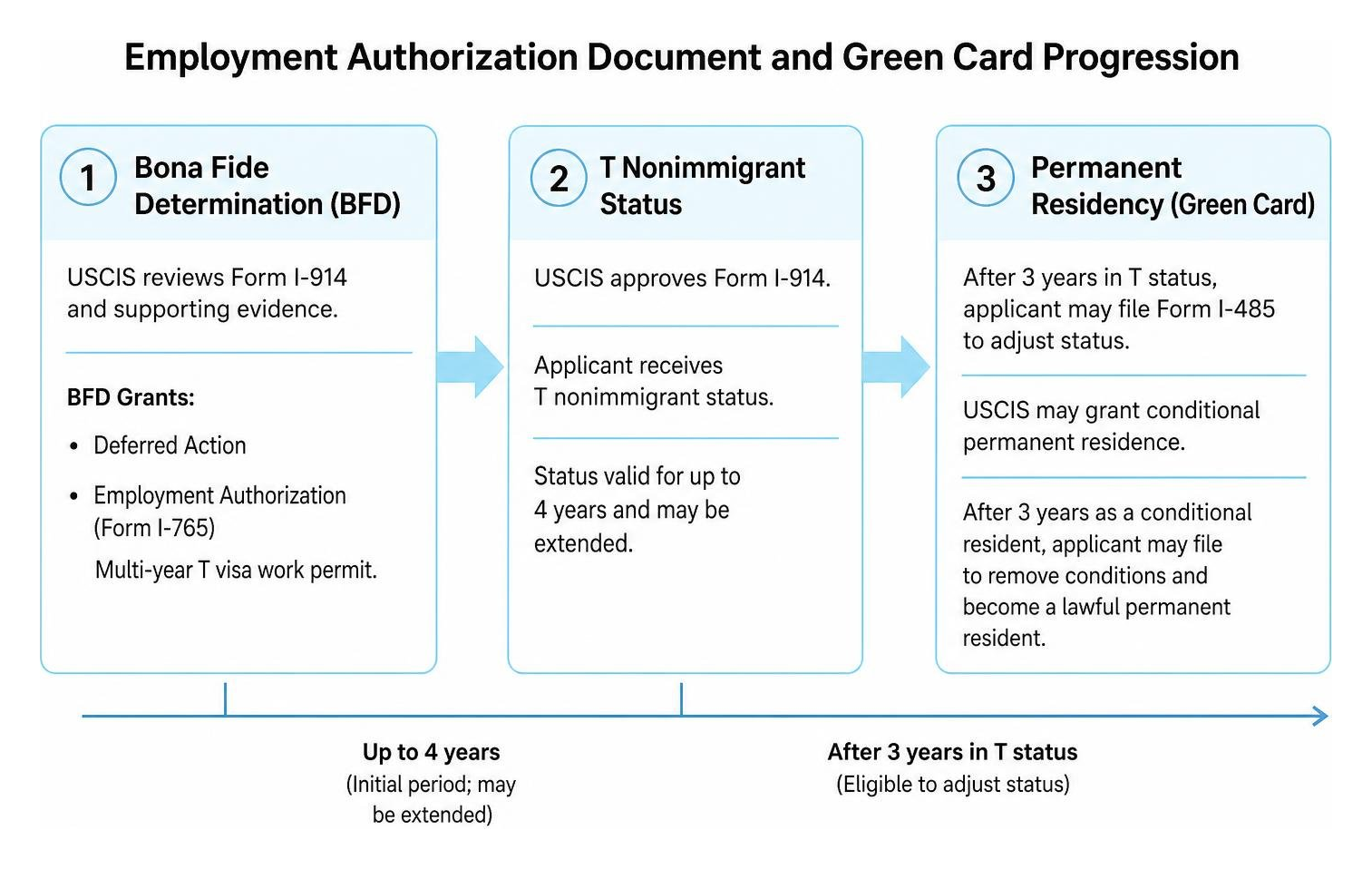
Once USCIS conducts an initial review of the I-914 and determines it is complete and supported by prima facie evidence, the agency issues a Bona Fide Determination (BFD).
A bona fide determination grants:
- Deferred Action: Temporary administrative protection from deportation.
- Employment Authorization: A multi-year T visa work permit issued under Form I-765.
Survivors also become eligible for Office of Refugee Resettlement (ORR) benefits, Medicaid, and Supplemental Nutrition Assistance Program (SNAP) support through Health and Human Services (HHS) certification or Continued Presence status.
After maintaining continuous physical presence in lawful T nonimmigrant status for at least three years (or upon official certification that the investigation or prosecution of the trafficking is complete), the survivor can apply for lawful permanent residence (a Green Card) by filing Form I-485.
Navigating Removal Proceedings While Pursuing T Visa Relief
Applicants in removal proceedings before the Executive Office for Immigration Review (EOIR) can pursue T nonimmigrant relief concurrently. USCIS maintains sole jurisdiction to adjudicate Form I-914. Guidance outlined in NAVIGATING REMOVAL PROCEEDINGS WHILE PURSUING SURVIVOR-BASED FORMS OF RELIEF AT USCIS highlights how attorneys seek continuances or administrative closure from Immigration Judges while awaiting USCIS decisions.
Recent BIA Case Precedents and Federal Injunctions
Immigration court proceedings have seen critical shifts:
- Matter of Cahuec Tzalam and Matter of Ibarra-Vega: The Board of Immigration Appeals (BIA) introduced restrictive standards, suggesting continuances or administrative closures exceeding six months carry a presumption of being unreasonable.
- ICWC v. Noem: Federal court orders and ongoing litigation have challenged and enjoined policies that arbitrarily truncate immigration relief for crime and trafficking victims.
Legal representatives must present strong evidence of prima facie eligibility—such as formal receipt notices, detailed statements, and forensic psychological reports—to secure necessary court continuances while USCIS completes its review.
Frequently Asked Questions About T Visa Qualifications
How long does it take for USCIS to process a T visa application in 2026?
Form I-914 applications take between 6 and 18 months for comprehensive adjudication at the Vermont Service Center. However, applicants often receive a Bona Fide Determination granting interim work authorization and deferred action within 60 to 90 days of filing.
What happens if law enforcement refuses to sign Form I-914 Supplement B?
A signed Supplement B is not required. You can satisfy the cooperation requirement by providing secondary evidence, including hotline reporting receipts, certified personal statements, communication logs, and clinical evaluations establishing a trauma exception.
What federal public benefits can I access once my T visa is approved?
T visa holders and individuals granted HHS Certification or Continued Presence are eligible for federally funded assistance on par with refugees. These benefits include Medicaid, SNAP (food stamps), Supplemental Security Income (SSI), cash assistance through TANF, and job training programs administered by the Office of Refugee Resettlement.
Conclusion: Securing Humanitarian Protection and Expert Psychological Support
Obtaining a T visa provides crucial legal safety, work authorization, and a stable road to permanent residency for survivors of severe human trafficking. Because establishing trauma exceptions and demonstrating unusual and severe harm require clear clinical documentation, working with experienced professionals is essential to presenting an effective case.
At District Counseling, we provide trauma-informed forensic psychological evaluations for immigration matters across Texas—including Houston, Katy, Cypress, Sugar Land, Austin, Dallas, and San Antonio—as well as clients in Florida, California, New York, Utah, Virginia, and Idaho. We conduct comprehensive Spanish-language evaluations translated into English and provide six free post-report therapy sessions to help survivors navigate their healing journey.
If you or a loved one are preparing a petition and require a clinical assessment, schedule your confidential evaluacion psicologica para caso de tvisa with our team today.