
When Mental Health Decides Your Future in Immigration Court
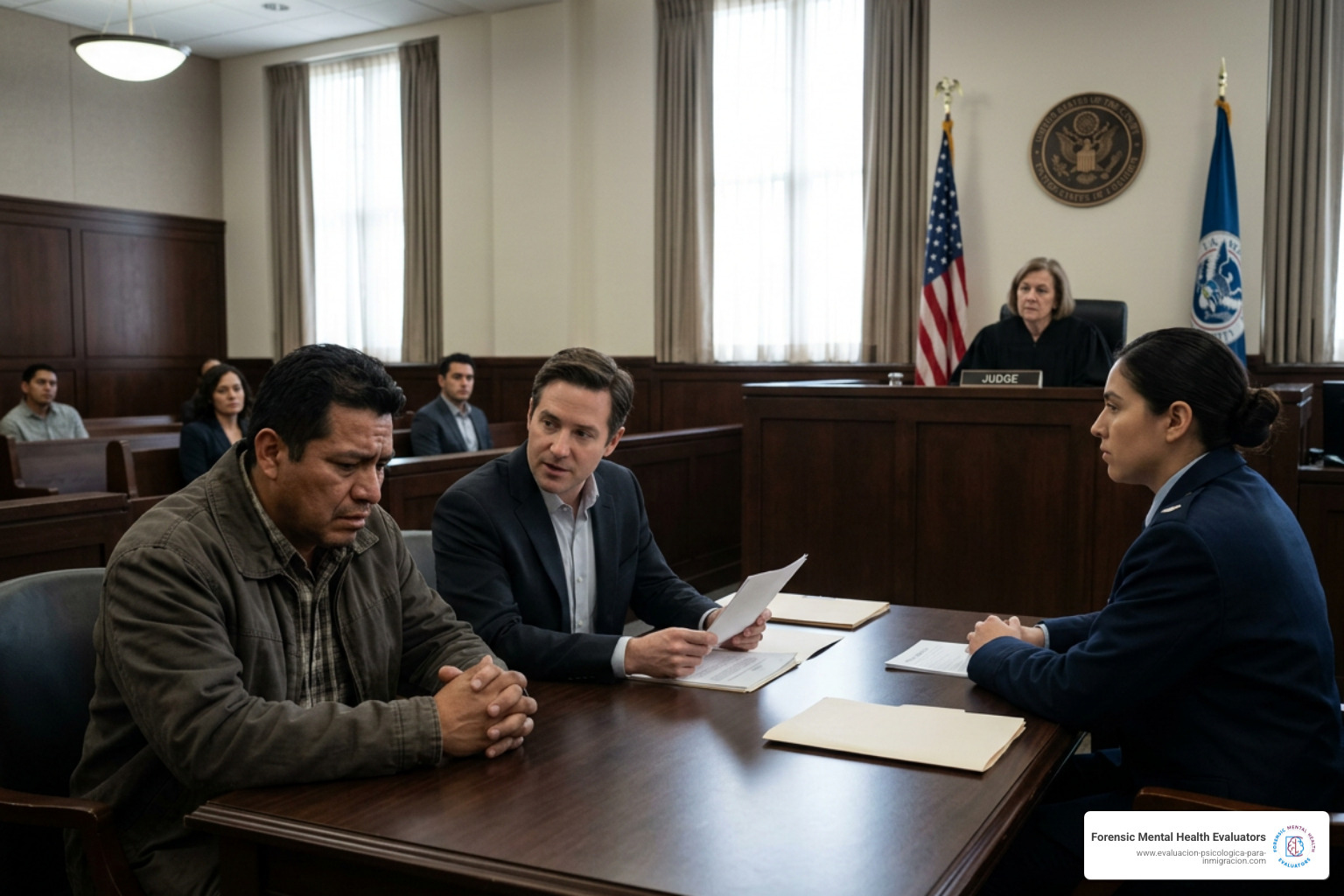
Immigration court mental health evidence can be the difference between staying with your family in the U.S. and being deported. If you are facing removal proceedings and wondering how your mental health — or the emotional impact on your U.S. citizen children or spouse — fits into your case, here is a quick answer:
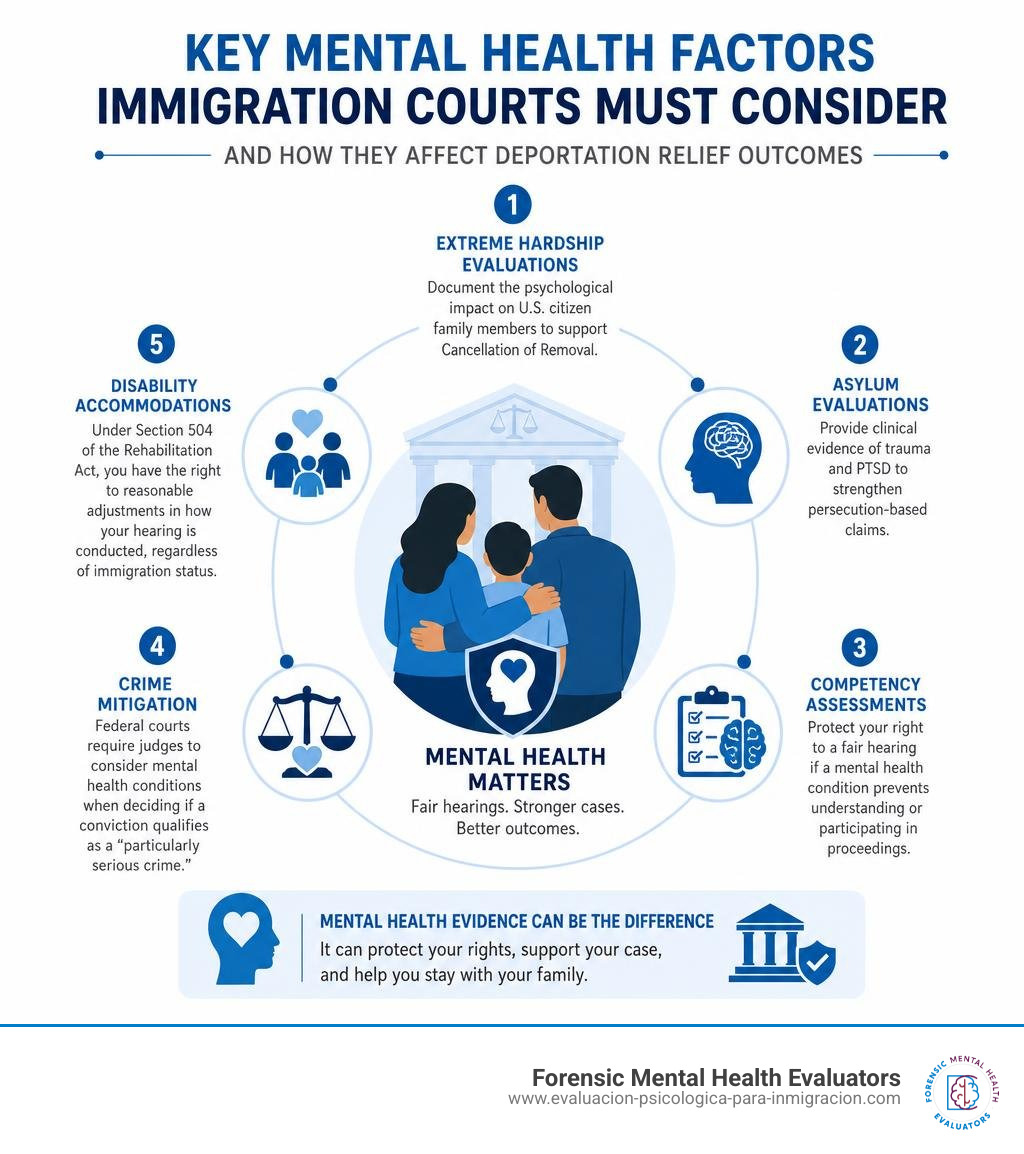
Key ways mental health matters in immigration court:
- Extreme hardship evaluations document the psychological damage deportation would cause your U.S. citizen family members, which can support Cancellation of Removal.
- Asylum evaluations provide clinical evidence of trauma and PTSD to strengthen persecution-based claims.
- Competency assessments protect your right to a fair hearing if a mental health condition prevents you from understanding or participating in proceedings.
- Crime mitigation — federal courts now require immigration judges to consider mental health conditions when deciding if a conviction qualifies as a "particularly serious crime."
- Disability accommodations — under Section 504 of the Rehabilitation Act, you have the right to reasonable adjustments in how your hearing is conducted, regardless of your immigration status.
Every day, people undertake dangerous journeys to reach the United States, only to face removal proceedings — often without a lawyer, and without anyone to explain how their trauma or mental illness is legally relevant to their case. About 15% of those in immigration detention have a psychiatric disorder, yet most never receive a professional evaluation that could meaningfully change the outcome of their case.
I am Francisco Ortiz, Lead Forensic Mental Health Evaluator at Forensic Mental Health Evaluators, a Certified Forensic Mental Health Evaluator (CFMHE) licensed across six states, with specialized training in competency evaluations, asylum assessments, and hardship waivers at the intersection of immigration court mental health and forensic psychology. In the sections below, I will walk you through exactly how mental health evidence works in immigration court and what you can do to protect your rights.
The Critical Role of Immigration Court Mental Health Evaluations
When navigating the complex and often intimidating U.S. immigration system, many respondents find themselves overwhelmed. Unlike criminal courts, where defendants are constitutionally guaranteed a defense attorney, immigration courts operate under civil administrative law within the Department of Justice (DOJ). This means that thousands of individuals must represent themselves pro se in front of an immigration judge.
In this high-stakes environment, an objective, third-party Immigration Mental Health Evaluation is one of the most powerful tools available to secure legal relief.
Forensic Assessments and the Role of Mental Health Professionals
A forensic mental health evaluation is fundamentally different from clinical therapy. While therapy focuses on healing and ongoing treatment, a forensic evaluation is designed to answer specific legal questions for the court. Forensic practitioners act as objective evaluators rather than advocates, relying on clinical interviews, standardized diagnostic testing, and a thorough review of medical and personal records.
According to research highlighted in Mental Health Evaluations in Immigration Court, these evaluations bridge the gap between complex psychological conditions and the rigorous legal standards of immigration law. Licensed professionals conduct these assessments to identify severe psychiatric disorders—such as Major Depressive Disorder, Generalized Anxiety Disorder, or Post-Traumatic Stress Disorder (PTSD)—and translate these clinical findings into a formal Psychological Report.
To maintain credibility in court, we must adhere strictly to clinical objectivity. This includes screening for response styles and malingering (the intentional feigning of symptoms) using validated forensic assessment instruments. By presenting an unbiased, scientifically grounded clinical picture, we provide immigration judges with the reliable data they need to make life-altering judicial decisions.

How an Immigration Court Mental Health Evaluation Supports Relief
Mental health evidence serves as the cornerstone for several common forms of relief from deportation:
- Asylum and Fear-Based Claims: For individuals fleeing persecution, a detailed psychological assessment is crucial. Many asylum seekers struggle to recall specific dates or details due to trauma-induced memory gaps. A forensic evaluator can document how a client's PTSD directly affects their memory and cognitive processing, explaining these inconsistencies to the judge. To understand this process in depth, you can consult our Asylum Psychological Assessment Complete Guide.
- Extreme Hardship Waivers (Form I-601/I-601A): To secure a waiver, a noncitizen must prove that their deportation would cause "extreme hardship" to a qualifying U.S. citizen or lawful permanent resident relative. A psychological evaluation documents the profound emotional, cognitive, and systemic impact of separation or relocation on the family unit.
- Cancellation of Removal: This defense against deportation requires showing "exceptional and extremely unusual hardship" to qualifying U.S. citizen or permanent resident relatives. Our Cancellation Removal Psych Evaluation Guide 2026 explains how we document these extreme psychological dynamics to support legal counsel in build a compelling case.
Determining Mental Competency Under Matter of M-A-M-
One of the most critical, yet historically neglected, areas of immigration court mental health is the issue of legal competency. For decades, individuals with severe cognitive impairments or active psychosis were routinely ordered deported because they could not comprehend the proceedings or assist their counsel.
This changed significantly with the Board of Immigration Appeals (BIA) landmark 2011 decision, Matter of M-A-M-, which established a structured framework for assessing mental competency in removal proceedings.
The Three-Prong Competency Test
Under the Matter of M-A-M- framework, all respondents in immigration court are legally presumed to be competent. However, if there are "indicia of incompetency"—such as erratic courtroom behavior, a history of psychiatric hospitalizations, or an inability to answer basic questions—the immigration judge is legally required to assess the respondent’s competency.
As detailed in this legal Practice Advisory, the BIA established a three-prong test to determine whether a respondent is mentally competent to participate in their removal proceedings:
- Rational and Factual Understanding: Does the respondent understand the nature and object of the proceedings (e.g., do they know what a judge is, what deportation means, and why they are in court)?
- Ability to Consult with Counsel: Can the respondent rationally consult with their attorney or representative to help build their defense?
- Reasonable Opportunity to Participate: Does the respondent have a reasonable opportunity to examine the government's evidence, present their own evidence, and cross-examine witnesses?
It is vital to understand that a medical diagnosis of mental illness is not the same as a legal finding of incompetence. A client may struggle with severe depression or PTSD but still remain legally competent to stand trial.
| Feature | Medical/Clinical Diagnosis | Legal Mental Competency |
|---|---|---|
| Primary Focus | Identifying clinical symptoms, mental illnesses, and cognitive disorders. | Assessing functional capacity to understand court proceedings and assist counsel. |
| Governing Standard | Diagnostic and Statistical Manual of Mental Disorders (DSM-5-TR) or ICD-11. | Legal precedents (e.g., Matter of M-A-M-, Reid v. Garland). |
| Determined By | Licensed mental health professionals (psychologists, psychiatrists). | The presiding Immigration Judge (relying on expert evaluations). |
| Implication | Guides clinical treatment, therapy, and psychiatric medication plans. | Determines if procedural safeguards or administrative closure are legally required. |
Reid v. Garland and the Requirement for Tailored Safeguards
When an immigration judge finds a respondent incompetent, the proceedings do not automatically grind to a halt. Unlike criminal courts, which focus on "restoration of competency," immigration courts must implement "procedural safeguards" to ensure the hearing remains fundamentally fair.
The scope of these safeguards was greatly reinforced by the Second Circuit Court of Appeals in the landmark case REID v. GARLAND (2024). In this case, the court ruled that immigration judges cannot bypass making an explicit, on-the-record competency finding by simply applying generic, informal accommodations (such as allowing the respondent to remain seated or asking simplified questions).
Instead, Reid v. Garland establishes that if there are manifest indicia of incompetency, the judge must:
- Make a formal, explicit finding regarding the respondent's competency.
- Generate a detailed record of the severity and scope of the individual's mental limitations.
- Implement specific, tailored safeguards designed to protect the respondent's exact due process rights (such as administrative closure to allow for psychiatric treatment, or the appointment of a legal representative).
Legal Protections and Procedural Safeguards in Detention
Immigration detention is an incredibly punitive and stressful experience. For the estimated 15% of detained noncitizens struggling with severe mental illness, these harsh conditions can cause rapid clinical deterioration.
Without robust advocacy and clear psychological evidence, many detained individuals face prolonged confinement, solitary placement, and unlawful deportation.
Section 504 of the Rehabilitation Act and the Franco Class
For legal representatives and mental health experts working with detained clients, Section 504 of the Rehabilitation Act of 1973 is a vital shield. Section 504 prohibits federal agencies—including the Department of Homeland Security (DHS) and the Executive Office for Immigration Review (EOIR)—from discriminating against individuals based on their disabilities. This protection applies to all individuals within the United States, regardless of their immigration status.
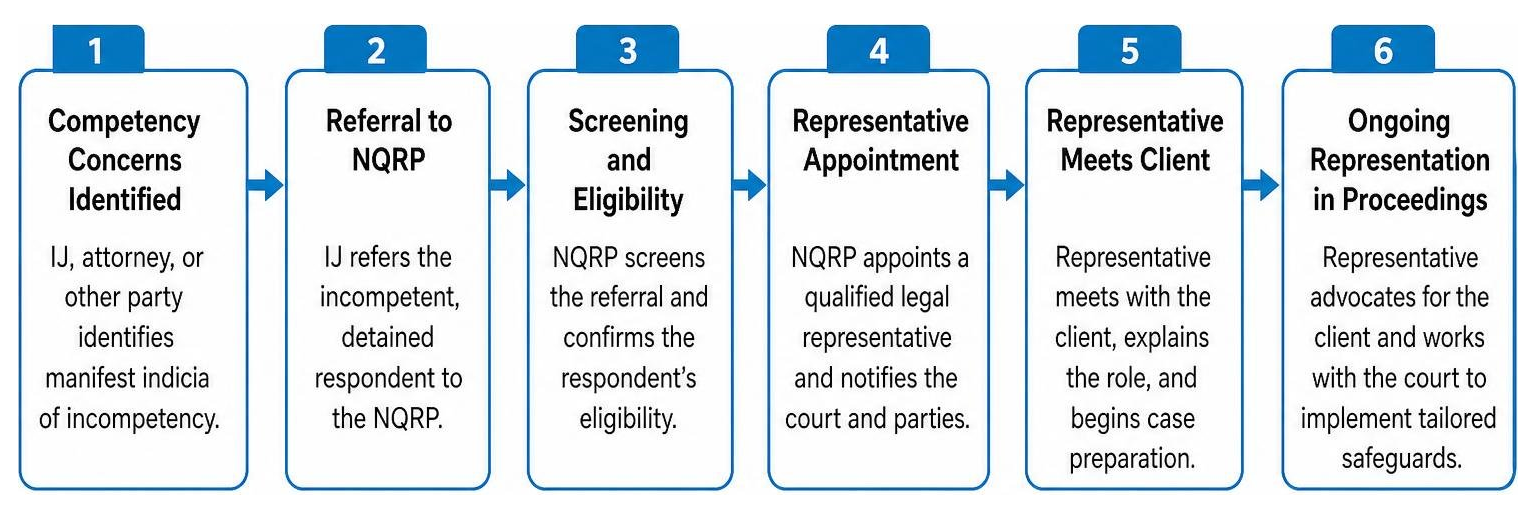
A major milestone in civil rights litigation occurred with the class-action lawsuit Franco-Gonzalez v. Holder. This case established that detained, unrepresented noncitizens in California, Arizona, and Washington who are found mentally incompetent due to a severe mental disability are entitled to a government-funded legal representative. This program, known as the National Qualified Representative Program (NQRP), provides a critical safeguard for vulnerable individuals.
For practitioners representing clients outside of these specific states, we must still utilize the legal arguments outlined in Advocating for and Representing Clients with Mental Illness. We can demand reasonable accommodations under Section 504, such as modified questioning, extended continuances, or release from detention if the facility cannot provide adequate psychiatric care.
Mitigating Particularly Serious Crimes with Mental Health Evidence
In many removal proceedings, the government argues that a respondent is ineligible for asylum or withholding of removal because they have been convicted of a "particularly serious crime" (PSC). Historically, the Board of Immigration Appeals held a categorical ban on considering mental health evidence when performing a PSC analysis, arguing that the focus should remain solely on the elements of the crime.
However, recent federal appellate decisions have overturned this restrictive stance. In landmark rulings such as Gomez-Sanchez v. Sessions (9th Circuit) and Shazi v. Wilkinson (8th Circuit), federal courts held that a categorical ban on mental health evidence is arbitrary and capricious.
Furthermore, the BIA's decision in Matter of B-Z-R- officially established that an individual's mental health status at the time of the offense must be considered as a mitigating factor. As detailed in the Use of Mental Health Evidence in Immigration Court, a comprehensive forensic evaluation can show that a respondent's erratic behavior during the offense was a direct symptom of their diagnosed mental illness (such as acute psychosis or severe PTSD), rather than an indication of inherent dangerousness to the community. This mitigation can preserve their eligibility for withholding of removal and protection under the Convention Against Torture (CAT).
Key Challenges in Immigration Court Mental Health Cases
Representing clients with severe mental illness or cognitive deficits presents a unique set of ethical, clinical, and logistical hurdles for both attorneys and mental health professionals.
Overcoming Cultural and Linguistic Barriers in Immigration Court Mental Health Assessments
Conducting a forensic evaluation across different cultures and languages requires much more than simply hiring an interpreter. Many standard psychological testing instruments are Eurocentric and carry inherent cultural biases, which can lead to inaccurate diagnoses or skewed cognitive scores if applied blindly.
As discussed in Challenges and Opportunities for Forensic Mental Health in Immigration Courts, we must approach every evaluation with deep cultural humility. This is especially true when assessing trauma and PTSD in Latinx immigrant populations, who frequently express emotional distress through somatic (physical) symptoms such as chronic headaches, stomach pain, or body aches, rather than traditional psychological terms.
Furthermore, we must recognize the clinical differences between standard PTSD and Complex PTSD (C-PTSD). C-PTSD, which is recognized in the ICD-11, includes "disturbances in self-organization" (DSO)—such as profound emotion dysregulation, persistent feelings of worthlessness, and severe relationship difficulties. C-PTSD is a far more accurate clinical formulation for asylum seekers who have endured chronic, systemic trauma over many years.
To ensure the highest level of clinical and legal integrity, we recommend working with a specialized Texas Immigration Psychological Expert who can conduct evaluations directly in the client's native language, eliminating the risk of translation errors.
Attorney Strategies for Securing Evaluations and Release
To build a robust defense for a client with mental competency issues, attorneys should implement several strategic steps:
- File Comprehensive FOIA Requests: Secure the client's complete "A-file" (alien file) and medical records from ICE custody immediately. DHS is not legally mandated to automatically share these records with the immigration judge, meaning critical psychiatric histories are often hidden unless actively requested.
- Coordinate Independent Evaluations Early: DHS-funded or facility-contracted medical evaluations often carry an inherent conflict of interest, as the evaluating agency is also the one seeking deportation. Securing an independent, private forensic evaluator ensures an objective assessment.
- Implement De-escalation Plans: Work closely with the client's family and therapists to develop safety and de-escalation plans, avoiding reliance on detention guards or law enforcement who may misinterpret psychiatric symptoms as non-compliance.
Frequently Asked Questions About Mental Health in Immigration Court
Can a mental health condition stop my deportation?
Yes. While a mental health condition itself is not a standalone legal status, a professional psychological evaluation provides the objective, empirical evidence required to support various forms of deportation relief.
As outlined in our Immigration Evaluations Complete Guide 2026, these evaluations document the extreme hardship on your U.S. citizen relatives, substantiate the trauma underlying your asylum claim, or trigger mandatory procedural safeguards if you are found incompetent to stand trial.
Who pays for a mental competency evaluation in immigration court?
In many cases, the cost of an independent evaluation falls on the respondent or their family. While the immigration judge or DHS can request an evaluation, relying on government-contracted evaluators can sometimes present a conflict of interest. Investing in an independent, private forensic evaluation ensures that the clinical assessment is conducted by an objective, specialized expert who is thoroughly trained in cross-cultural psychology and immigration law.
How does a psychological evaluation affect my credibility in court?
Under the landmark framework of Matter of J-R-R-A-, if an applicant's severe mental illness causes them to present inconsistent, fragmented, or delusional testimony, the immigration judge should generally accept that the applicant genuinely believes what they have presented.
Instead of applying standard adverse credibility findings, the judge must recognize that these inconsistencies are clinical symptoms of documented trauma, PTSD, or cognitive deficits, rather than a deliberate attempt to deceive the court. A detailed psychological report is essential to establish this clinical link for the judge.
Conclusion
Navigating the intersection of immigration court mental health and federal law requires a highly specialized, interdisciplinary approach. A cookie-cutter psychological assessment is simply not enough to meet the rigorous standards of an immigration judge or USCIS officer.
At District Counseling, we provide comprehensive, culturally sensitive psychological evaluations tailored to the unique legal needs of immigration cases, including U-Visas, T-Visas, VAWA, Asylum, and Cancellation of Removal. We proudly serve clients across Texas—including Houston, Katy, Cypress, Sugar Land, Austin, Dallas, and San Antonio—as well as virtually through secure, interjurisdictional telepsychology across Florida, California, New York, Utah, Virginia, and Idaho.
Our Unique Commitment to Your Journey:
- Bilingual Spanish Evaluations: We conduct our clinical interviews directly in Spanish and provide certified English translations for the court, ensuring your story is told accurately without linguistic loss.
- Uncompromising Client Comfort: We understand that discussing past trauma is incredibly difficult. We provide a warm, safe, and trauma-informed environment.
- Post-Report Healing: Unlike traditional forensic evaluators who exit your life once the report is signed, we believe in long-term support. We offer 6 free therapy sessions after completing your evaluation to help you process trauma and navigate court-induced stress.
If you or a loved one are facing removal proceedings, do not leave your future to chance. Schedule a professional psychological evaluation with our experienced, compassionate team today, and let us help you build the strongest possible defense for your case.