
How to Prove Exceptional Hardship in Cancellation of Removal

A cancellation of removal exceptional hardship claim must show that your removal would harm a U.S. citizen or lawful permanent resident spouse, parent, or child far more than removal normally harms a family. Start by identifying that relative, then gather records that show what would happen to them if they stayed in the United States without you or moved with you. Medical records, school reports, financial documents, and a psychological evaluation can help show how those harms add up.
Hardship is only one part of the case. Non-permanent residents must also meet the rules for physical presence, good moral character, and criminal history. This guide explains how to document the hardship and avoid gaps in the evidence.
I’m Francisco Ortiz, a certified forensic mental health evaluator with training in immigration hardship assessments. In cases involving exceptional hardship in cancellation of removal, I focus on documenting a qualifying relative’s mental health needs and the likely effects of removal.
Legal Standard: Cancellation of Removal Exceptional Hardship Explained

When an undocumented individual or non-permanent resident faces deportation in immigration court, non-LPR cancellation of removal serves as one of the most critical forms of defensive relief. Codified under Section 240A(b)(1)(D) of the Immigration and Nationality Act (INA) and set forth in the 8 U.S.C. § 1229b statutory criteria, this provision allows an Immigration Judge (IJ) to cancel removal proceedings and adjust an applicant's status to that of a lawful permanent resident (LPR).
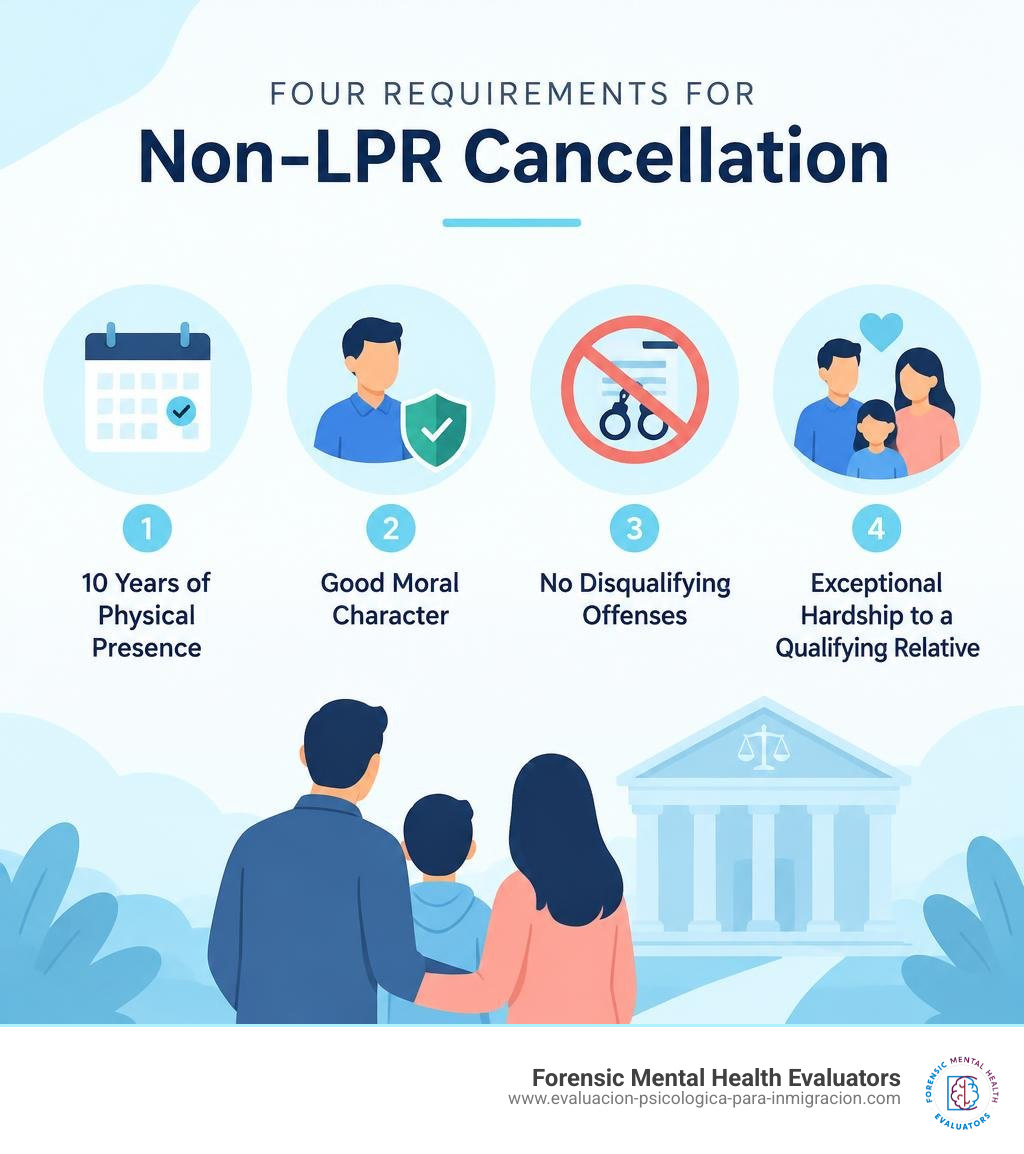
However, obtaining this relief requires clearing an exceptionally high bar. Beyond establishing ten years of continuous physical presence and good moral character without disqualifying criminal offenses, the applicant must prove that their deportation would cause "exceptional and extremely unusual hardship" to a qualifying relative.
To grasp this standard, one must understand how the Board of Immigration Appeals (BIA) interprets the hardship legal definition. The BIA has repeatedly held that the hardship must be "substantially different from, or beyond, that which would normally be expected from the deportation of an alien with close family members here." In other words, the standard emotional pain, economic disruption, and logistical distress that naturally accompany the separation of a family or relocation abroad do not satisfy the statute.
The foundational framework for this standard rests upon a triad of precedent BIA decisions:
- Matter of Monreal (23 I&N Dec. 56, BIA 2001): The Board established that while hardship need not be "unconscionable," it must be truly exceptional. In Monreal, the applicant had lived in the U.S. for twenty years, but his children were healthy, young, and bilingual. The Board ruled that routine financial strain and family separation were insufficient.
- Matter of Andazola (23 I&N Dec. 319, BIA 2002): The Board reinforced that economic deprivation, lower standards of education, and diminished economic opportunities in the country of origin do not amount to exceptional and extremely unusual hardship, even when the applicant is an unmarried parent supporting two U.S. citizen children.
- Matter of Recinas (23 I&N Dec. 367, BIA 2002): Representing the outer boundary of what succeeds, Recinas established that a case where an applicant was the sole financial provider for six children, had no family support network in Mexico, and spoke limited native language resources barely cleared the threshold.
Adding to this legal difficulty is a strict statutory bottleneck: Congress has capped non-LPR cancellation of removal grants at 4,000 approvals per fiscal year. With hundreds of thousands of active cases pending before immigration courts nationwide, an applicant must present a compelling, multi-layered, and cumulatively documented hardship narrative to secure one of these highly limited visa numbers.
Extreme Hardship vs. Exceptional and Extremely Unusual Hardship
Immigration law contains several distinct hardship thresholds, and mixing them up can be fatal to a legal defense. Many individuals are familiar with the "extreme hardship" standard applied in provisional unlawful presence waivers under INA § 212(a)(9)(B)(v) or special-rule applications governed by 8 C.F.R. § 1240.66 special rule guidelines.
The table below contrasts standard extreme hardship against the heightened non-LPR cancellation standard:
| Factor / Dimension | Extreme Hardship (e.g., I-601 / I-601A Waivers) | Exceptional and Extremely Unusual Hardship (EOIR-42B Non-LPR Cancellation) |
|---|---|---|
| Statutory Threshold | Significant hardship beyond standard separation, but not extraordinary. | Hardship that is substantially beyond that ordinarily expected from removal. |
| Eligible Relatives | U.S. Citizen (USC) or LPR spouse or parent (children excluded in certain waivers). | USC or LPR spouse, parent, or child under 21 years old. |
| Self-Hardship Considered? | Yes, in specific humanitarian or domestic violence contexts (e.g., VAWA). | No. Hardship to the applicant cannot be considered directly. |
| Economic Impact | Significant reduction in standard of living can carry substantial weight. | Severe economic loss alone is insufficient unless combined with catastrophic medical or developmental needs. |
| Medical / Psychological Burden | Well-documented chronic conditions requiring management. | Severe, debilitating conditions requiring specialized care that is entirely unavailable abroad. |
To understand how these standards diverge in practice, practitioners frequently refer to our detailed comparison of extreme and exceptionally unusual hardship alongside our extreme hardship waiver guide.
Qualifying Relatives and the Limits of Hardship Claims
One of the most rigid aspects of Section 240A(b)(1)(D) is the definition of a qualifying relative. Under the statute, hardship can only be claimed regarding:
- A spouse who is a U.S. citizen (USC) or lawful permanent resident (LPR).
- A parent who is a USC or LPR.
- An unmarried child under the age of 21 who is a USC or LPR.
If an applicant has lived in the United States for decades, built successful businesses, and paid taxes reliably, none of their personal suffering matters under the letter of the statute. An IJ cannot approve cancellation of removal based on the hardship the applicant personally would experience upon return to their native country.
Furthermore, hardship to non-qualifying family members—such as adult children over 21, undocumented spouses, siblings, or elderly grandparents—cannot be directly considered. The legal team must instead demonstrate how the suffering of non-qualifying family members creates a severe, derivative psychological or financial crisis for the qualifying relative. Understanding this distinction is vital when navigating the overall removal process immigration guide.
Evaluating Cumulative Factors and Evidentiary Thresholds in Non-LPR Cases

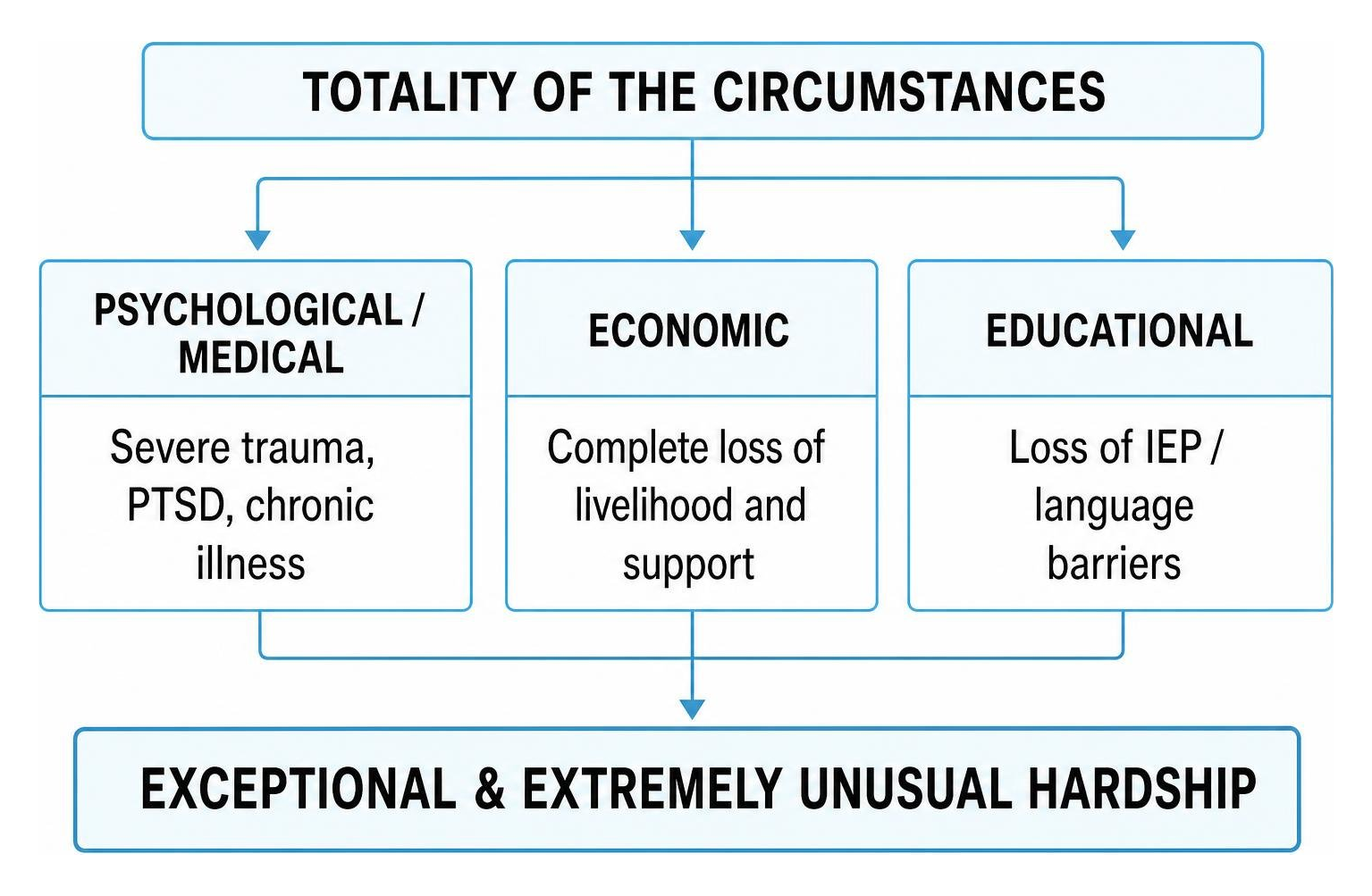
Immigration judges do not assess hardship in isolated silos; they are legally bound to evaluate the totality of the circumstances. While a single issue—such as a moderate wage decrease—will result in a denial, multiple compounding difficulties can collectively cross the exceptional threshold.
These cumulative factors typically include:
- Financial and Caregiving Dependency: Whether the respondent is the sole financial provider or the primary daily caregiver for a disabled relative.
- Educational and Linguistic Disruption: How the relocation would affect children who do not speak the foreign language and rely on specialized educational plans.
- Geographic and Socioeconomic Context: As illustrated in the First Circuit analysis in Domingo-Mendez v. Garland, factors such as the applicant's age, lack of recent occupational experience in the home country, and severe regional economic depression are weighed to evaluate if the family faces complete financial destitution.
- Family Separation Dynamics: The catastrophic emotional toll if the qualifying relative remains in the United States alone.
For a broader breakdown of how these components fit together, explore our non-LPR cancellation guide.
Meeting the Burden for Cancellation of Removal Exceptional Hardship Under Matter of J-J-G-
In 2020, the BIA issued a pivotal decision in Matter of J-J-G- (27 I&N Dec. 808, BIA 2020) that reshaped how medical and psychological claims must be litigated.
Under Matter of J-J-G-, when an applicant claims exceptional hardship based on a qualifying relative’s health condition, they must meet a strict, two-pronged burden of proof:
- Establish a Serious Medical or Mental Health Condition: The qualifying relative must suffer from a severe illness, developmental disorder, or psychological impairment that requires continuous, specialized care.
- Prove Inadequacy or Unavailability of Care Abroad: The applicant must affirmatively demonstrate that adequate medical or psychiatric treatment is not reasonably available in the country of removal, or that the cost of such care is completely prohibitive relative to their realistic earning capacity.
In Matter of J-J-G-, the respondent claimed his daughter had hypothyroidism and his mother had hypertension. However, the BIA rejected the claim because the respondent failed to submit credible, corroborating evidence showing that standard thyroid medication was unobtainable in Guatemala, and evidence showed his mother was already receiving accessible treatment locally.
This precedent established that general assertions about "poor third-world healthcare" will fail. Practitioners must submit country conditions reports, clinical price indices, and hospital availability statements to satisfy Matter of J-J-G-, an essential strategy across all removal defense immigration matters.
Child Psychology vs. Comparative Legal Standards
One of the sharpest points of tension in cancellation proceedings exists between clinical science and immigration jurisprudence.
From a neurobiological and developmental perspective, decades of peer-reviewed child psychology confirm that the sudden, involuntary removal of a primary caregiver causes acute, toxic stress. This disruption frequently leads to:
- Attachment disorders and regression in emotional milestones.
- Elevated risks of chronic clinical depression and severe anxiety.
- Disruption of executive functioning and educational development.
- Long-term neurochemical changes associated with adverse childhood experiences (ACEs).
Yet, immigration courts operate under a comparative standard. Because Congress intended cancellation of removal to be rare, judges often reason: "Every child whose parent is deported experiences trauma. What makes this child's trauma worse than the rest?"
This creates what clinicians call the "healthy child paradox." If a child is doing well in school and exhibits no prior psychiatric diagnoses, an immigration judge may rule that the child is resilient enough to adapt to separation or relocation. Conversely, if the child is already struggling with a major neurodevelopmental or psychiatric condition (such as Autism Spectrum Disorder, major depressive disorder, or severe ADHD), the loss of the parent's daily stabilizing presence creates a demonstrable, catastrophic disruption that bridges the gap between normal distress and statutory exceptional hardship.
Proving Medical and Psychological Hardship: Strategies and Clinical Documentation
Submitting an EOIR-42B Application form without exhaustive clinical corroboration is one of the quickest routes to a denial. Immigration judges review hundreds of hardship claims annually; boilerplate letters from treating physicians or family acquaintances carry minimal weight.
To successfully establish statutory hardship, the evidentiary filing should weave together:
- Longitudinal medical records showing diagnosis dates, treatment compliance, and prognosis.
- Individualized Education Programs (IEP), 504 plans, and standardized testing reports for school-aged children.
- Detailed expert declarations regarding specialized medical dependencies.
- A comprehensive, trauma-informed psychological evaluation for cancellation of removal.
Medical and Psychological Evidence for Cancellation of Removal Exceptional Hardship
When compiling clinical evidence, our evaluations focus on documenting functional impairment rather than merely listing symptom checklists.
Common diagnoses that form the foundation of successful hardship petitions include:
- Major Depressive Disorder (MDD) and Persistent Depressive Disorder: Documenting vegetative symptoms, suicidal ideation, and acute functional decline.
- Post-Traumatic Stress Disorder (PTSD): Detailing how familial separation triggers intrusive recollections, hyperarousal, and emotional detachment.
- Generalized Anxiety Disorder and Panic Disorder: Assessing panic frequency, somatic manifestations, and debilitating anticipatory anxiety.
- Neurodevelopmental Conditions (ADHD, ASD, Learning Disabilities): Demonstrating the precise, daily interventions provided by the respondent that cannot be replicated in a foreign educational system.
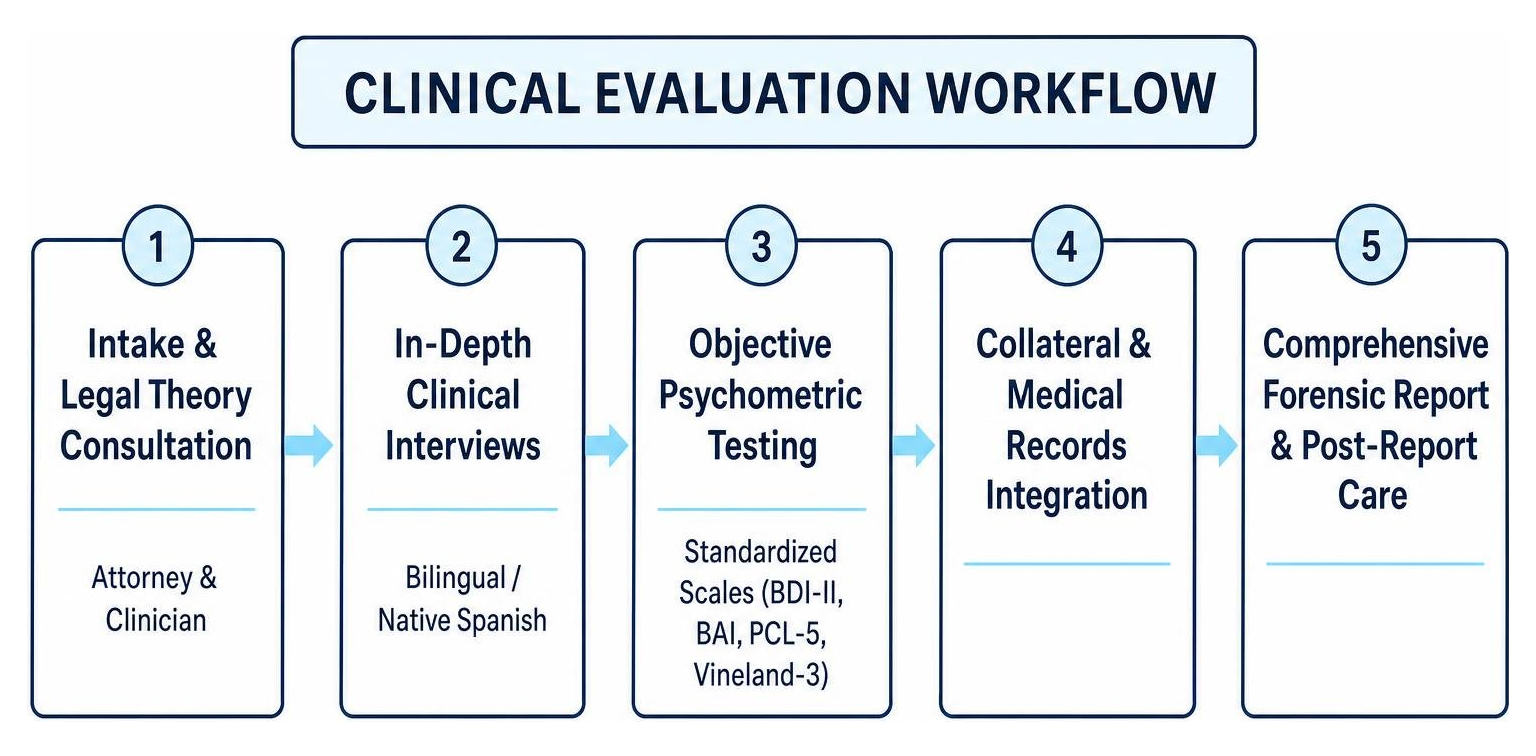
Our forensic reports integrate standardized diagnostic instruments (such as the BDI-II, BAI, PCL-5, and Vineland-3) to provide quantitative, objective validity to the qualitative hardship narrative.
Best Practices for Attorney-Psychologist Collaboration
A successful hardship defense requires seamless synergy between the legal strategist and the forensic mental health clinician.
Key best practices include:
- Early Case Referrals: Contacting the evaluator months before the individual calendar hearing to allow adequate time for thorough clinical interviews and collateral record reviews.
- Bilingual Evaluations: Conducting assessments directly in the client's native language (such as Spanish) to capture cultural idioms of distress without loss in translation.
- Dual-Scenario Analysis: Ensuring the psychological evaluation evaluates both potential outcomes: the hardship to the relative if they accompany the respondent abroad, and the hardship if they remain in the United States separated from the respondent.
- Ongoing Mental Health Support: Providing continuity of care. At District Counseling, every evaluation includes six free therapy sessions post-report to ensure qualifying relatives receive meaningful mental health support during this stressful legal process.
Common Pitfalls, Evidentiary Weaknesses, and Proposed Legal Reforms
Many cancellation of removal applications fail not because the family lacks genuine suffering, but because the evidence was presented ineffectively.
Key Vulnerabilities That Lead to Hardship Denials
- Uncorroborated Economic Arguments: Claiming that the respondent cannot earn a living abroad without submitting wage data, employment market analyses, or economic studies from the home country.
- Speculative Medical Claims: Asserting that a qualifying relative cannot obtain medication abroad without providing pharmacy price sheets, health ministry reports, or expert letters establishing local shortages.
- Treating School Performance in Isolation: Submitting basic report cards showing low grades without an accompanying educational evaluation or IEP proving a specialized learning disability.
- Reliance on "Normal" Family Sadness: Presenting testimony that focuses entirely on how much the children will miss their parent, without clinical evidence illustrating acute psychological decompensation.
Policy Debates and the "Best Interests of the Child" Standard
For over two decades, legal scholars, child advocates, and immigration practitioners have criticized the "exceptional and extremely unusual hardship" standard for failing to align with modern international child welfare principles.
In family courts across the United States, custody and guardianship determinations are governed by the "best interests of the child" standard. This standard places the child's developmental, emotional, and psychological health at the center of the judicial inquiry.
In contrast, immigration law treats the child’s well-being as a secondary consideration, subordinate to strict statutory caps and heightened comparative standards. Proposed legislative reforms frequently advocate for amending INA § 240A(b) to incorporate a "best interests" framework, which would allow judges to prevent the traumatic separation of families without forcing parents to prove that their children have reached a clinical breaking point.
Frequently Asked Questions About Cancellation of Removal Hardship
What makes hardship "exceptional and extremely unusual" compared to ordinary hardship?
Ordinary hardship encompasses the expected, painful consequences of deportation—such as loss of household income, emotional sadness from separation, and adjusting to a lower standard of living abroad. Hardship becomes "exceptional and extremely unusual" when the qualifying relative suffers from severe medical conditions requiring unavailable care, debilitating psychiatric disorders, profound educational impairments, or when the cumulative weight of complete financial destitution and lack of family support creates an unmanageable crisis.
Can economic hardship alone satisfy the cancellation of removal standard?
Under longstanding precedent (Matter of Andazola), economic hardship alone is virtually never enough to satisfy the statutory threshold. However, if economic devastation directly causes the total loss of life-sustaining medical care, specialized therapy, or basic survival necessities for a qualifying relative, it can be combined with health and psychological factors to meet the cumulative hardship burden.
How does medical care availability in the country of removal impact the case?
Under Matter of J-J-G-, an applicant must prove that adequate medical care is not reasonably available in the country of removal. If the government demonstrates that standard public clinics in the foreign country treat the condition for free or at low cost, the hardship claim will likely be denied unless the applicant provides corroborated evidence showing regional shortages, systemic discrimination in healthcare access, or cost-prohibitive specialized treatments.
Conclusion
Securing relief under non-LPR cancellation of removal requires navigating one of the most stringent standards in United States immigration law. Success depends on moving beyond general narratives of hardship to construct a meticulously documented, interdisciplinary defense that weaves together legal analysis, objective medical data, and rigorous clinical evaluation.
At District Counseling, we provide specialized, bilingual psychological evaluations tailored to the complex demands of immigration proceedings across Texas, Florida, California, New York, Utah, Virginia, and Idaho. Our comprehensive evaluations document the clinical realities of qualifying relatives, offering immigration courts the clear, objective insights necessary to evaluate cumulative hardship. To schedule a clinical evaluation or learn more about our forensic services, explore our comprehensive immigration evaluation services.