
How to Find a Qualified Houston T Visa Expert

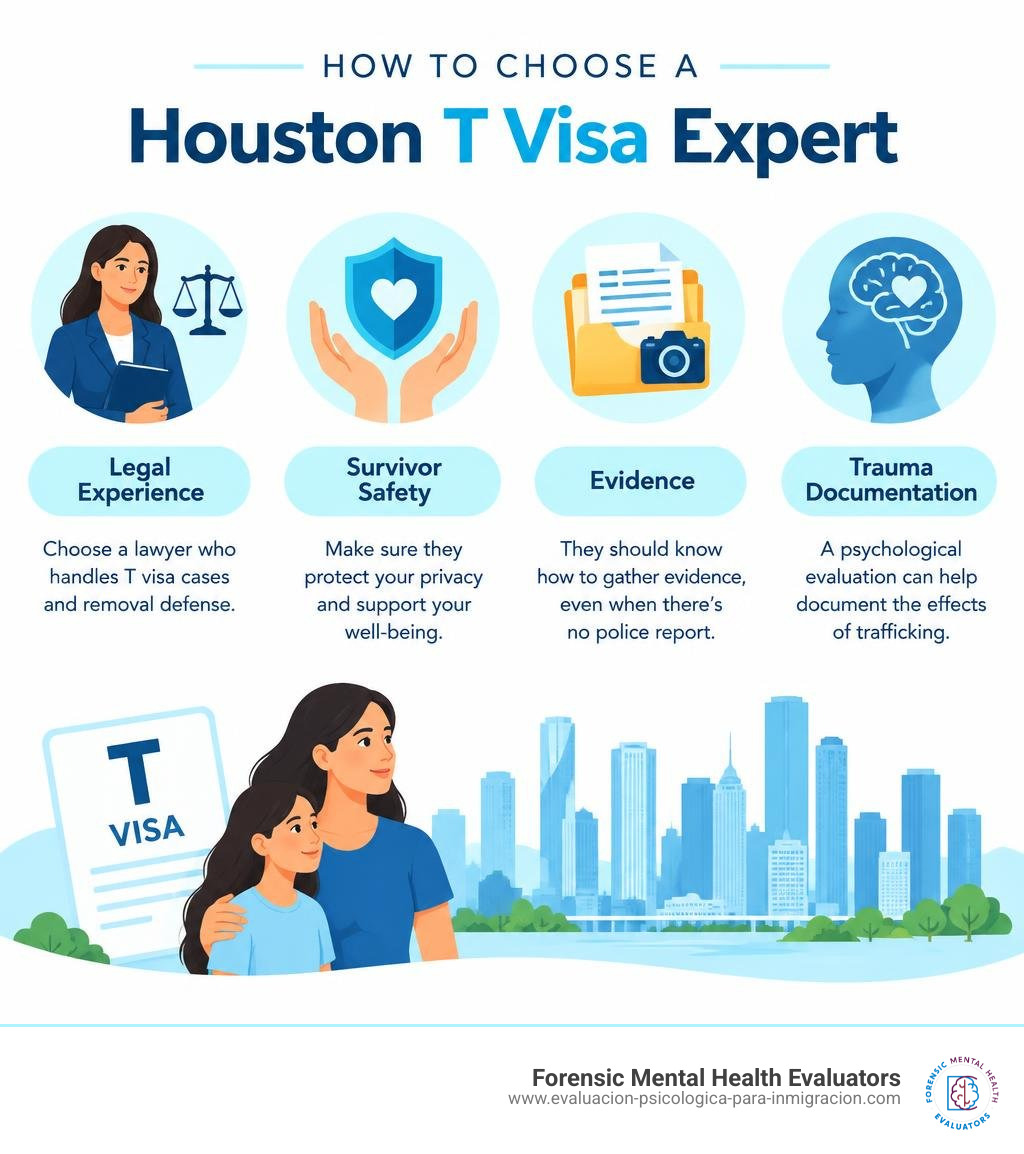
Start with an immigration lawyer who handles T visa cases and removal defense. Ask how they protect your privacy, gather evidence when there is no police report, and address trauma in the application. A psychological evaluation may help document the effects of trafficking, but it does not replace legal representation.
T visas can offer protection to survivors of severe labor or sex trafficking. If you have a removal order or a pending deportation case, tell the lawyer at your first meeting so they can assess your options promptly. Finding a qualified Houston T visa expert often means working with a legal team that understands both the immigration process and the mental health needs of trafficking survivors.
I'm Francisco Ortiz, lead forensic mental health evaluator at District Counseling PLLC, where I prepare immigration evaluations and have specialized training in assessing trafficking survivors. If you searched for "t visa expert houston," my role is to help document trauma while your immigration lawyer handles the legal case.
Understanding Severe Trafficking and Humanitarian Relief in Texas
Navigating immigration law after enduring severe exploitation can feel overwhelming. In diverse hubs like Harris County, Katy, Cypress, and Sugar Land, immigrant communities are vibrant yet vulnerable. In fact, nearly one in four Houston residents was born outside the United States, and close to half of all local children have at least one immigrant parent, as highlighted in our Houston Immigration Guide 2026.
Meeting statutory T Visa Eligibility criteria requires proving four distinct elements under federal law:
- Severe Form of Trafficking: You must be a victim of sex trafficking (induced by force, fraud, or coercion, or involving a minor) or labor trafficking (the recruitment, harboring, transportation, provision, or obtaining of a person for labor or services through force, fraud, or coercion for involuntary servitude, peonage, debt bondage, or slavery).
- Physical Presence: You must be physically present in the United States, American Samoa, the Commonwealth of the Northern Mariana Islands, or at a port of entry on account of such trafficking.
- Assistance to Law Enforcement: You have complied with any reasonable request for assistance in the investigation or prosecution of human trafficking (unless under age 18 or unable to cooperate due to physical or psychological trauma).
- Extreme Hardship: You would suffer extreme hardship involving unusual and severe harm upon removal from the United States.
Many survivors do not immediately self-identify as trafficking victims because they associate the term exclusively with physical chains or kidnapping. Under U.S. law, psychological coercion, wage confiscation, and deceptive recruitment qualify just as clearly.
Signs You May Have a Valid Human Trafficking Claim

Trafficking often begins with an ordinary promise: a decent job in construction, domestic work, restaurant services, or agriculture, or perhaps a romantic relationship that turns coercive. Over time, control sets in through subtle manipulation or direct intimidation.
Recognizing the signs of exploitation is the first step toward safety under the T Visa program:
- Document Confiscation: An employer, smuggler, or partner keeps your passport, birth certificate, or identification to restrict your movement.
- Debt Bondage: You are told you owe an impossible, ever-increasing debt for travel, housing, or food that can never be paid off despite working long hours.
- Wage Theft and Excessive Hours: Working 12 to 16 hours a day with little to no pay, or having your earnings routinely docked for fabricated expenses.
- Threats of Immigration Reporting: Constant threats that calling the police or leaving the job will result in immediate detention or deportation.
- Isolation and Surveillance: Being forbidden from speaking with family, locked inside worksites, monitored via cameras, or escorted everywhere.
- Coerced Commercial Sex: Being pressured, tricked, or forced into commercial sex acts to repay debts or keep shelter.
Comparing T Visas, U Visas, and Asylum Protections
Survivors often ask whether a T visa, a U visa, or asylum is the right path forward. Experienced immigration attorneys evaluate the specific circumstances of each case to determine the most viable option.
| Relief Option | Qualifying Grounds | Law Enforcement Requirement | Path to Permanent Residency |
|---|---|---|---|
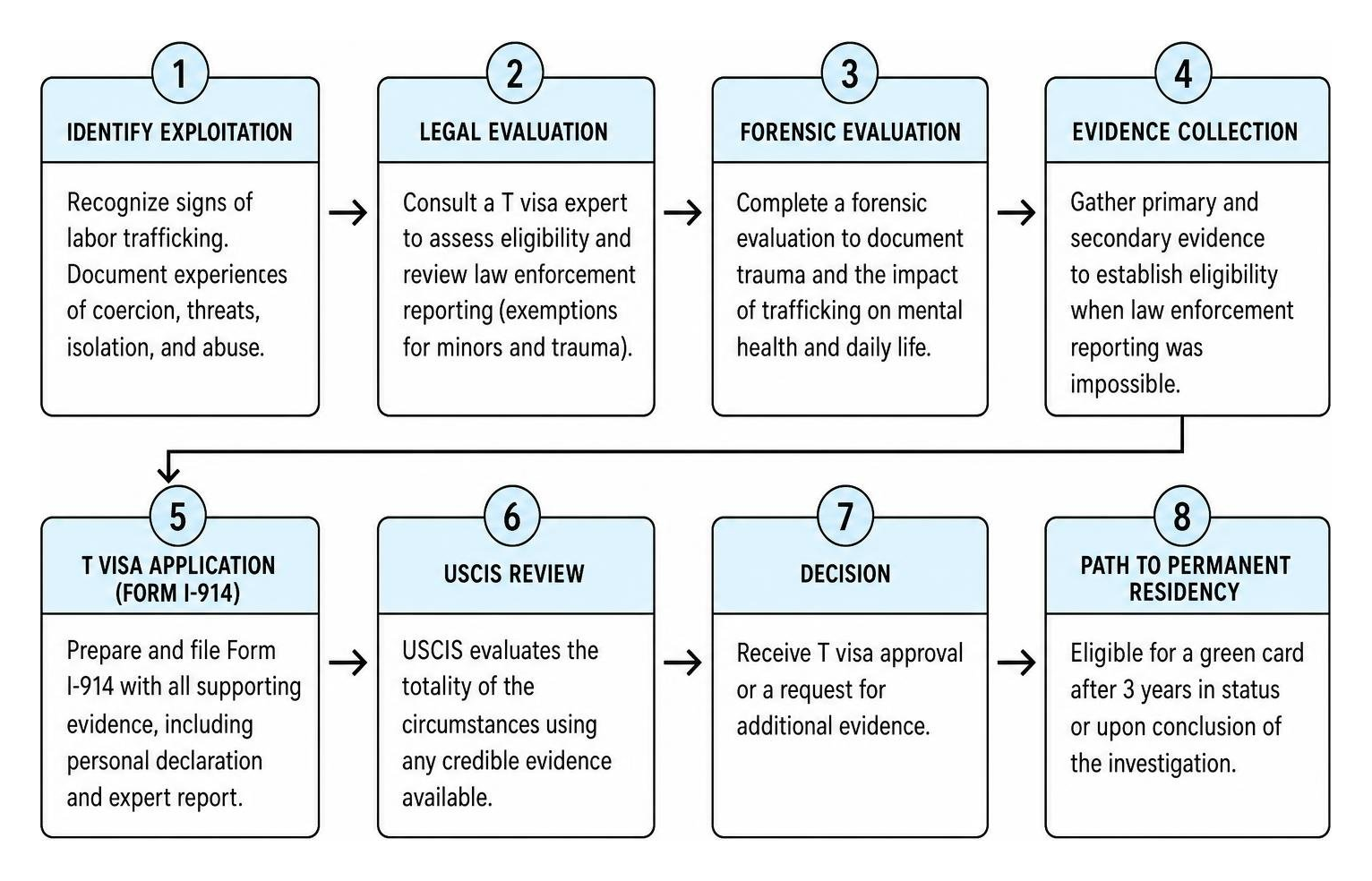
| T Visa (Form I-914) | Severe forms of sex or labor trafficking | Must comply with reasonable requests (exemptions for minors and trauma) | Eligible after 3 years in status (or upon conclusion of investigation) |
| U Visa (Form I-918) | Victims of qualifying crimes (e.g., felonious assault, domestic violence, extortion) who suffered substantial physical/mental abuse | Mandatory Form I-918 Supplement B signed by an authorized certifying official | Eligible after 3 years of continuous physical presence in U status |
| Asylum (Form I-589) | Past persecution or well-founded fear of persecution based on race, religion, nationality, political opinion, or particular social group | No requirement to cooperate with U.S. law enforcement | Eligible to apply for a green card 1 year after asylum grant |
Unlike the U visa, which strictly requires a signed law enforcement certification, the T visa permits applicants to establish eligibility through comprehensive primary and secondary evidence if law enforcement reporting was impossible due to trauma or other valid reasons.
Essential Legal Strategies Used by a T Visa Expert in Houston
Successfully presenting a trafficking claim requires a coordinated approach between legal counsel and forensic evaluators. In high-volume jurisdictions, legal advocates screen for underlying immigration complications while crafting a robust factual narrative.
Building Corroborating Evidence Beyond Police Reports
A common misconception is that without a 911 call or an active police investigation, a T visa cannot be filed. USCIS evaluates the totality of the circumstances using any credible evidence:
- Detailed Personal Declaration: A comprehensive, chronological statement describing the recruitment, the means of coercion used, the daily conditions of labor or servitude, and why leaving felt impossible.
- Digital Footprints: Text messages, WhatsApp chats, voicemails, social media exchanges, and call logs demonstrating threats, control, or unpaid wages.
- Financial and Employment Records: Bank statements, wire transfer receipts, handwritten debt ledgers, timecards, or pay stubs reflecting sub-minimum wage payments.
- Third-Party Witness Statements: Affidavits from coworkers, neighbors, community members, religious leaders, or shelter staff who observed the working conditions or restrictions on freedom.
- Medical and Incident Records: Hospital visits, clinic notes, injury documentation, or domestic violence shelter intake logs.
Documenting Hardship Through Psychological Evaluations
Because human trafficking inflicts severe emotional, cognitive, and psychological harm, a comprehensive forensic evaluation is often pivotal in establishing both the victimization and the statutory extreme hardship requirement.
At District Counseling, we conduct specialized immigration evaluations across Texas, California, Florida, New York, Virginia, Utah, and Idaho. Our bilingual team conducts in-depth clinical interviews in Spanish and English to evaluate conditions such as Post-Traumatic Stress Disorder (PTSD), Major Depressive Disorder, and Generalized Anxiety Disorder resulting from trafficking.
A thorough T Visa Psych Report connects the clinical findings directly to the legal standard. It explains how returning to the home country would cause extreme hardship—such as lack of specialized mental health infrastructure, fear of retribution from transnational trafficking networks, social stigma, or severe re-traumatization. For detailed clinical criteria, refer to our T Visa Psychological Evaluation Guide. To support our clients' long-term healing, we also provide six free therapy sessions post-report.
Step-by-Step Filing Process for Houston Trafficking Survivors
Filing for humanitarian relief requires strict adherence to USCIS procedural rules. Knowing each phase of the journey helps reduce anxiety throughout the process.

Preparing Form I-914 and Meeting Law Enforcement Requirements
The foundational petition is prepared using the official I 914 Form (Application for T Nonimmigrant Status).
Key steps during preparation include:
- Completing Form I-914 Supplement B (Optional but Recommended): This form serves as formal law enforcement endorsement confirming the applicant was a victim of trafficking and complied with reasonable requests for assistance. If law enforcement declines to sign or contact was never initiated due to trauma, the applicant submits credible secondary evidence alongside a trauma exemption statement.
- Filing Form I-192 for Inadmissibility Waivers: If an applicant entered without inspection, accrued unlawful presence, or was coerced into unlawful acts by the trafficker, Form I-192 (Application for Advance Permission to Enter as a Nonimmigrant) is filed concurrently to waive these grounds in the public or humanitarian interest.
- Establishing a Safe Mailing Address: Because safety is paramount, applicants can designate their attorney's office or a secure alternative mailing address on Form I-914 to ensure correspondence never falls into the hands of an abuser.
Securing Work Permits, Derivative Visas, and Green Cards
A major milestone during this process is obtaining a T Visa Work Permit. Applicants can concurrently file Form I-765 (Application for Employment Authorization). Once USCIS makes a positive bona fide determination or approves the petition, an Employment Authorization Document (EAD) is issued under category (c)(25) or (a)(16), providing legal work authorization and access to a Social Security Number.
T visa holders can also protect qualifying family members by filing Form I-914 Supplement A for derivative visas:
- If the Principal Applicant is Under 21: May petition for their spouse, unmarried children under 21, parents, and unmarried siblings under 18 (T-4 visa).
- If the Principal Applicant is 21 or Older: May petition for their spouse and unmarried children under 21.
- Special Derivatives: In certain circumstances, adult or minor children facing danger of retaliation due to the principal’s escape or cooperation can also be included.
After maintaining continuous physical presence in T nonimmigrant status for at least three years—or upon the official certification that the investigation/prosecution is complete—the survivor can file Form I-485 to adjust status to a Lawful Permanent Resident (Green Card holder).
Overcoming Obstacles: Denials, Removal Orders, and Processing Times
Trafficking cases are complex, and systemic backlogs can create challenges. Knowing what lies ahead allows applicants to plan accordingly, supported by our comprehensive Immigration Psychological Evaluations Guide 2026.
What to Expect During USCIS Processing and RFEs
Processing a T visa currently takes anywhere from 17 to 36 months or more, depending on USCIS service center caseloads. Fortunately, historical approval rates remain strong, typically exceeding 70% to 80% when cases are supported by thorough documentation.
During this timeline, USCIS may issue a Request for Evidence (RFE). An RFE is not a denial; rather, it is a formal request for clarification or additional proof—such as further details regarding the means of coercion, corroboration of physical presence, or deeper clinical analysis of extreme hardship. Working closely with an evaluator and attorney ensures timely, comprehensive RFE responses.
How a Houston T Visa Expert Handles Denials and Removal Orders
If an individual has an outstanding final order of removal, they are still legally permitted to file for T nonimmigrant status. Filing Form I-914 places an automatic administrative stay on certain removal proceedings once a bona fide determination is issued.
If an application is faced with a T Visa Denied decision, several legal avenues remain:
- Motion to Reopen or Reconsider (Form I-290B): Filed within 33 days to present new facts or demonstrate an erroneous application of immigration law.
- Administrative Appeals Office (AAO): Appealing an improper adverse decision to the administrative appellate body.
- Federal Court Litigation: Filing an action under the Administrative Procedure Act (APA) or a writ of mandamus in U.S. District Court if agency decisions are arbitrary or unreasonably delayed.
Budgeting for Legal Representation With a T Visa Expert Houston Claimants Trust
USCIS does not charge a filing fee for Form I-914 or Form I-914 Supplement A. Fee waivers (Form I-912) are also available for associated forms like Form I-192 if financial hardship exists.
Attorney legal fees for humanitarian representation vary, often ranging around several thousand dollars, with many practitioners offering structured monthly installment plans. Investing in qualified legal guidance combined with an objective forensic evaluation gives applicants the strongest possible foundation for long-term legal security.
Frequently Asked Questions About Houston T Visa Cases
How long does USCIS take to process a T visa in Houston?
Most T visa adjudications take between 17 and 36 months. However, applicants may receive a bona fide determination earlier in the process, granting interim deferred action and employment authorization while the final petition is reviewed.
Can I qualify for a T visa without reporting to local police?
Yes. While law enforcement cooperation is a standard requirement, the law provides explicit exceptions for survivors under 18 years of age and individuals who suffered physical or psychological trauma that prevents them from reporting. Detailed clinical psychological evaluations and personal statements serve as critical evidence in these instances.
What immediate benefits are available once a T visa is approved?
Upon approval, survivors receive lawful nonimmigrant status for up to 4 years, an unrestricted work permit (EAD), eligibility for certain federally funded refugee assistance benefits (such as cash, medical, and housing assistance via the Office of Refugee Resettlement), and a clear statutory bridge to apply for permanent residency.
Conclusion
Securing legal status through a T visa is a transformative step toward reclaiming autonomy, safety, and peace of mind. Whether you are living in Houston, Katy, Cypress, Sugar Land, or elsewhere across Texas, assembling a compassionate, qualified team makes all the difference.
At District Counseling, we work collaboratively with immigration attorneys across the nation to provide meticulous, trauma-informed mental health evaluations in English and Spanish. If you are preparing your humanitarian filing, learn more about our specialized Evaluacion Psicologica Para Caso De Tvisa services and take advantage of our supportive, client-first care—including six complimentary post-report therapy sessions to support your healing journey.